


Global foundries report their highest sales growth in a decade... "Only Samsung can challenge TSMC."
 Published2020.11.19 14:50
The battle for semiconductor equipment is set to intensify, both for 12/8-inch and 14/16-inch chips.
Samsung's 5nm capacity will reach 80% of TSMC's in Q4 2021.
The foundry market is booming, driven by factors such as the increased demand for high-performance mobile phones and infrastructure due to the promotion of remote education and work and the full-scale commercialization of 5G.
Taiwanese market research firm TrendForce predicted on the 18th that global foundry revenue this year would increase by 23.8% year-on-year, the highest increase in a decade.
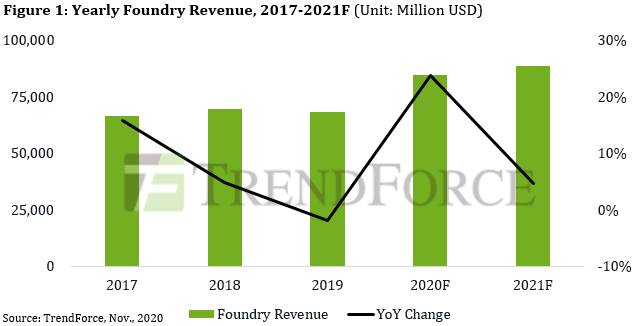
[Graph = TrendForce]
TrendForce forecasts that current semiconductor demand will continue through the first half of 2021. TSMC and Samsung Electronics' sub-10nm semiconductor production capacity (CAPA) is at a level where they cannot accept additional orders.
With the 4nm process expected to be operational in 2021 and the 3nm process expected to be operational in 2022, the industry is also fiercely competing to secure ASML's Extreme Ultra Violet (EUV) equipment, which enables a more precise exposure process than existing processes.
As the adoption of advanced microfabrication processes accelerates in 12-inch wafer-based fabs, the capacity of 8-inch wafer-based fabs is reaching saturation. This surge is driven by the commercialization of 5G, driving a significant increase in demand for PMICs used in smartphones and base stations. For semiconductors like PMICs and LDDI, 8-inch fabs are actually more cost-effective.
With few companies producing and supplying 8-inch wafer-based semiconductor equipment, prices have been rising sharply since the second half of 2019. Therefore, TrendForce predicts that the capacity shortage in 8-inch fabs will not ease in the short term.
◇ TSMC seeks to solidify its position, while Samsung Electronics pursues it alone.
Currently, TSMC's 5nm process is exclusively used by Apple, as HiSilicon, a Huawei subsidiary, is unable to place orders due to US sanctions. While Apple is placing CPU and FPGA orders, it cannot fill the gap left by HiSilicon, and thus its capacity this year is expected to remain at 85-90% of its capacity. Conversely, demand for TSMC's 5nm process is expected to continue to increase from 2021.
First, trial production of the Apple A15 Bionic SoC and AMD Zen 4 CPU will begin, and it is expected that MediaTek, Nvidia, and Qualcomm will place large-scale 4/5nm orders from late 2021 to 2022. Additionally, there is a high possibility that Apple will produce the A16 Bionic SoC using a 4nm process, which is an improvement on the 5nm process, which will likely lead to TSMC further expanding its 5nm capacity.
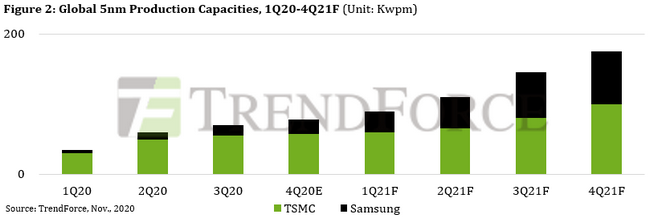
Samsung Electronics also plans to increase its 5nm capacity in 2021 to prepare for orders for NVIDIA's Hopper architecture-based GeForce GPUs, Qualcomm's Snapdragon 885, and its own Exynos flagship. Accordingly, Samsung Electronics' 5nm capacity is expected to reach 80% of TSMC's 5nm capacity. Other foundries, including Taiwan's UMC, the US's GlobalFoundries, and China's SMIC, do not have any processes below 7nm.
TrendForce analyzed that Qualcomm is likely to adopt TSMC's 4nm process for the production of the Snapdragon 895 SoC in the future, and with Intel outsourcing its CPU production to TSMC, Samsung Electronics is likely to remain the only 5nm process customer alongside Nvidia. As of the third quarter of this year, TSMC held a 53.9% global foundry market share, while Samsung Electronics held 17.4%.
Comments
Related news
Samsung Electronics Ships First EUV Process-Applied DRAM at Pyeongtaek Line 2
Samsung Electronics announced the commencement of operations at Pyeongtaek Line 2, the world's largest semiconductor production line. The line will produce third-generation 10-nanometer-class LPDDR5 mobile DRAM with EUV process technology applied for the first time in the industry. Additionally, the company plans to manufacture next-generation V-NAND and ultra-fine-pitch foundry products starting from the second half of 2021.
2020.08.31by 이수민 기자
2020 Fab Equipment Investments Expected to Be Highest in the Memory Sector
SEMI released its latest fab outlook report, projecting that global front-end process fab equipment investment will increase 8% this year and 13% next year. Memory fab equipment investment is expected to reach $26.4 billion this year, while foundry is projected to achieve $23.2 billion.
2020.09.09by 이수민 기자
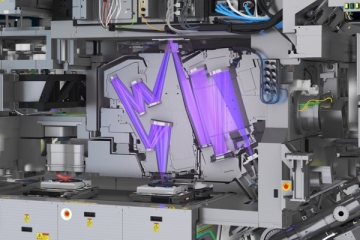
EUV, the Next-Generation Semiconductor Process, "Will It Survive Moore's Law?"
Since the 2010s, the difficulty of semiconductor process miniaturization has increased, resulting in slower improvements in semiconductor chip performance, which has raised questions about Moore's Law. However, with the full-scale introduction of EUV processes, Moore's Law is expected to be extended further. EUV has a wavelength of 13.5nm, which is much shorter than the 193nm of ArF that has been widely used traditionally, enabling higher precision in semiconductor lithography processes.
2020.11.19by 이수민 기자
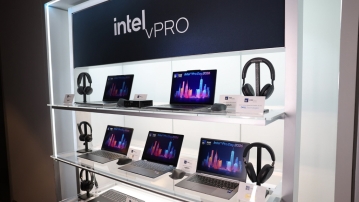
Intel Unveils Next-Generation 'Core Ultra Series 3' and vPro Platform for Enterprise PCs
Intel has officially unveiled the "Intel Core Ultra Series 3" for next-generation enterprise PCs and the latest vPro platform, addressing a wide range of demands from enterprise notebooks to high-performance workstations.
2026.03.26by 배종인 기자
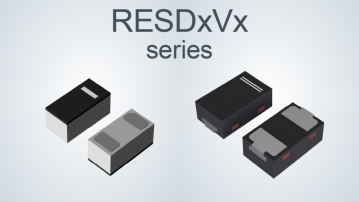
ROHM Launches ESD Protection Diode Compatible with High-Speed Interfaces of 10Gbps or Higher
Semiconductor specialist ROHM has developed the 'RESDxVx series' of ESD (electrostatic discharge) protection diodes capable of responding to next-generation high-speed data communication environments exceeding 10Gbps, simultaneously enhancing both signal quality maintenance required in high-speed interfaces and IC protection performance.
2026.03.26by 배종인 기자











