


Intel Seeks Acquisition of GlobalFoundries, "Will It Bet 34 Trillion Won?"
 Published2021.07.16 15:05
Intel's New CEO Pat Gelsinger Announces Entry into Foundry Business in March
If successful, it will go down as the third-largest deal between semiconductor companies in history.
Intel, having declared a resurgence as an integrated semiconductor company, is embarking on a major corporate deal. The target is GlobalFoundries, the world's fourth-largest foundry company as of the first quarter of this year. The acquisition is estimated at $30 billion (approximately 34 trillion won), and if successful, it is expected to become the third-largest deal between semiconductor companies in history, following the Nvidia-Arm acquisition and the AMD-Xilinx acquisition.
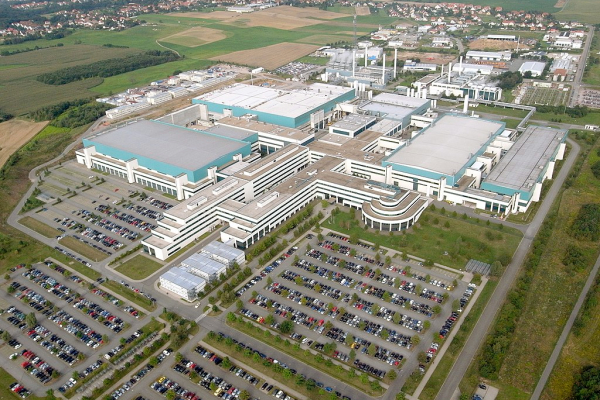
GlobalFoundries Dresden Fab [Photo=Fensterblick]
On the 15th, local time in the U.S., the Wall Street Journal reported that Intel is exploring the acquisition of GlobalFoundries. GlobalFoundries is currently owned by Mubadala, the sovereign wealth fund of Abu Dhabi in the United Arab Emirates, and its headquarters remain in the United States.
A GlobalFoundries spokesperson stated that no discussions are underway with Intel, and the media outlet determined that GlobalFoundries executives were not involved in the deal.
At his inauguration ceremony last March, Intel's new CEO, Pat Gelsinger, stated, "The foundry industry is expected to grow to at least $100 billion (approximately 114 trillion won) by 2025," and announced the 'IDM 2.0' strategy, which involves providing foundry services—previously used only for Intel's own chips—to other companies. Currently, Taiwanese companies such as TSMC and UMC hold approximately 65% of the global foundry market share, with us following closely behind at 18%.
Intel, with a market value estimated at $225 billion (approximately 256 trillion won), has pledged to invest more than $20 billion (approximately 23 trillion won) to expand its semiconductor manufacturing capabilities in the United States.
GlobalFoundries was spun off from AMD in 2009. AMD remains a major client of GlobalFoundries. Even this year, the company has signed a contract worth $1.6 billion (approximately 1.8 trillion won). The media outlet analyzed that this could make Intel's acquisition difficult.
Recently, as the shortage of automotive semiconductors has become severe, impacting areas such as home semiconductors, public interest in foundries has surged. Foundry companies are expanding their fabs to handle the flood of orders. GlobalFoundries also announced last June that it would invest $4 billion (approximately 4.5 trillion won) in the construction of an additional fab in Singapore.
This deal is expected to be the largest in Intel's history. Intel agreed last October to sell its NAND business to SK Hynix for approximately $9 billion (about 10.2 trillion won). In 2017, it acquired Mobileye, an Israeli ADAS specialist, for $15.4 billion (about 17.5 trillion won), and in 2015, it acquired Altera, an FPGA specialist, for $14 billion (about 16 trillion won).
Comments
Related news
Intel's entry into the foundry market is negative for Korea.
Due to accelerated semiconductor self-sufficiency driven by the U.S. reshoring policy, the accelerated collaboration between foundries and fabless companies within the United States is viewed negatively for Korea's foundry industry, and opinions have been raised that preparations are necessary to stabilize semiconductor supply and demand in our country.
2021.06.24by 배종인 기자
GlobalFoundries Expects 30% Price Increase in Q3
As semiconductor production capacity fails to keep pace with demand, global foundries including TSMC, SMIC, and UMC are reportedly planning unit price increases in the third quarter. The anticipated price increase is expected to be around 30%.
2021.06.30by 배종인 기자
.jpg)
The semiconductor equipment market is expected to boom to $100 billion by 2022.
Semiconductor equipment sales in 2022 are expected to reach a record high of 100 billion dollars. Continued investment by chip makers is accelerating growth in the front-end and back-end semiconductor equipment industries. Particularly this year, South Korea is projected to become the top investing country based on the recovery of the memory market and aggressive investment in foundry. Other countries are also expected to see increased investment compared to last year.
2021.07.14by 이수민 기자

Intel Unveils Next-Generation 'Core Ultra Series 3' and vPro Platform for Enterprise PCs
Intel has officially unveiled the "Intel Core Ultra Series 3" for next-generation enterprise PCs and the latest vPro platform, addressing a wide range of demands from enterprise notebooks to high-performance workstations.
2026.03.26by 배종인 기자

ROHM Launches ESD Protection Diode Compatible with High-Speed Interfaces of 10Gbps or Higher
Semiconductor specialist ROHM has developed the 'RESDxVx series' of ESD (electrostatic discharge) protection diodes capable of responding to next-generation high-speed data communication environments exceeding 10Gbps, simultaneously enhancing both signal quality maintenance required in high-speed interfaces and IC protection performance.
2026.03.26by 배종인 기자











