


Intel to build two foundries in Europe to meet mobility demand
 Published2021.09.08 16:14
Establishing two new fabs to address the EU mobility industry
Securing dedicated foundry capacity at existing Irish fab
Intel CEO Pat Gelsinger, in his first in-person keynote address since taking office as Intel president in February, predicted on the 8th that semiconductors will account for more than 20% of the total bill of materials (BOM) of premium vehicles by 2030. This figure represents a fivefold increase from 4% in 2019, and comes amidst an overall increase in semiconductor demand.
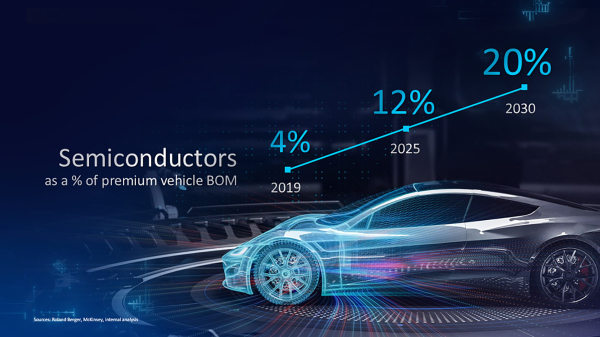
Changes in the proportion of semiconductors among raw materials [Figure = Intel]
Gelsinger CEO predicted that the total addressable market (TAM) of automotive semiconductors will reach $115 billion in 10 years, about double the current size, accounting for more than 11% of the entire semiconductor TAM. He said: “We will invest up to 80 billion euros over the next 10 years to build at least two fabs in Europe to serve the EU mobility industry.”
He then announced that Intel would secure dedicated foundry capacity at its Ireland fab and launch the 'Intel Foundry Services Accelerator' to enable automotive semiconductor designers to take advantage of advanced nodes.
CEO Pat Gelsinger also shared Intel's strategy for autonomous driving with Mobileye CEO Amnon Shashua. Shashua unveiled the company's first production Mobileye autonomous vehicle (AV), featuring the Mobileye Drive™ autonomous driving system and branded as the MoovitAV service.
He said, “Mobileye is committed to providing autonomous vehicles to consumers,” and “The new Mobileye AV, based on the Moovit AV service, is an important milestone on the road to a driverless world.” Starting next year, Mobileye plans to launch an autonomous ride-hailing service with Sixt SE in Munich, Germany. Commercial operation of driverless autonomous vehicle services became possible in Germany earlier this year.
Meanwhile, Jack Weast, Intel Fellow and Mobileye Vice President of Autonomous Driving Standards, discussed the recently completed Institute of Electrical and Electronics Engineers (IEEE) 2846 draft with Gelsinger. IEEE 2846, expected to be approved by the end of the year, will be the first autonomous vehicle safety standard to address "how safe is enough?"
“The IEEE 2846 standard will provide regulators with the essential tools they need to enable autonomous vehicles to operate on all roads,” said Vice President Wist.
Comments
Related news
BYD, which makes everything, aims to leap into IDM
Chinese semiconductor companies are experiencing rapid growth. However, most of them are fabless companies focused on design. In reality, the number of Chinese companies venturing into actual semiconductor, semiconductor equipment, and semiconductor material development is very small. Even fewer Chinese semiconductor companies can be called IDMs. BYD Semiconductor, which is famous for automotive semiconductors, is one of the few companies in China capable of in-house design, manufacturing, and packaging, and currently holds more than 15 core technologies. With 187 technology patents in its portfolio, it is one of the rare semiconductor companies able to respond to the needs of various Chinese companies.
2021.07.14by 이수민 기자
Xilinx and Motovis Develop Automotive Front Camera Solution
The front camera system is a key component of Advanced Driver Assistance Systems (ADAS) that provides advanced sensing capabilities required for critical safety functions such as Lane Keeping Assist (LKA), Autonomous Emergency Braking (AEB), and Adaptive Cruise Control (ACC). Xilinx and Motovista have developed a solution for vehicle recognition and control in automotive front camera systems by combining their respective automotive-grade SoC platforms and CNN IP.
2021.09.01by 이수민 기자
Mouser Introduces Key Components for Automotive Embedded Systems
Mouser stated that it has and supplies various new products designed to enable engineers to implement next-generation automotive electronics designs. These include Infineon's 32-bit automotive MCUs and multi-channel MOSFET driver ICs, Maxim Integrated's 4-channel automotive backlight drivers, Samtec's 400-pin COM-HPC interconnect arrays, and Molex's FFC jumpers, among others.
2021.09.01by 강정규 기자
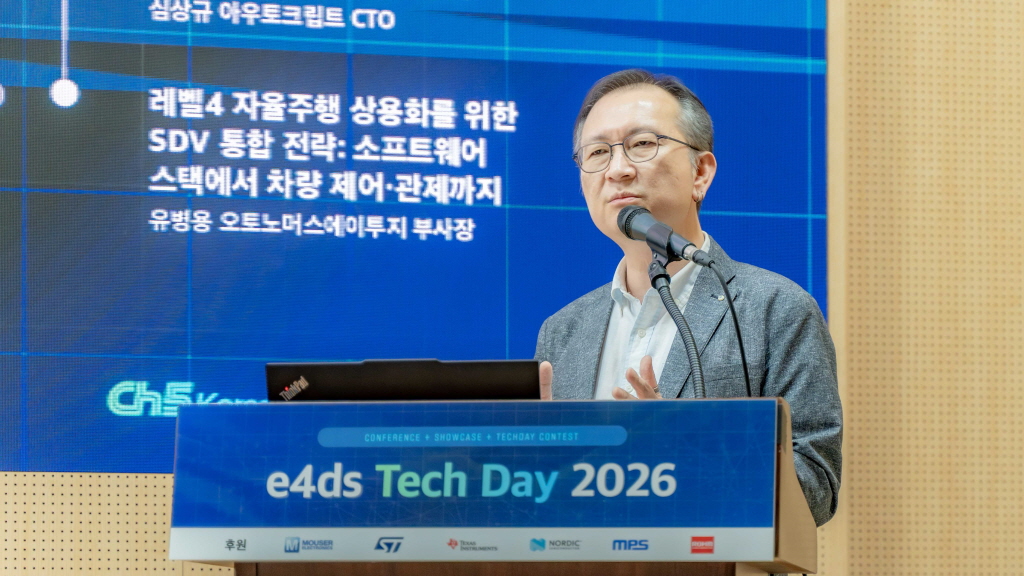
[e4ds Tech Day 2026 ⑨] Sim Sang-gyu, Autocrypt CTO: "In the Physical AI Era, Automotive Security Must Extend Beyond the Vehicle"
At e4ds Tech Day 2026, Sim Sang-gyu, CTO of Autocrypt, explained automotive cybersecurity strategies in the era of Physical AI and SDV (Software-Defined Vehicle). Automobiles are evolving as part of an ecosystem connected to AI, cloud, chargers, IoT, and robots, and he emphasized that the scope of security must expand beyond the vehicle interior to the entire connected environment. In particular, AI model tampering, adversarial attacks, OTA updates, and EV charger hacking were identified as major threats. He explained that response measures require zero trust, AI model integrity protection, intrusion detection, Security by Design and Default, and full lifecycle security management, and that proactive security system establishment beyond regulatory compliance is critical for securing future mobility competitiveness.
2026.10.12by 배종인 기자

Practical HIL Construction Strategy for Automotive and Off-Highway Controller Validation
As vehicle E/E architecture transitions to zonal structures and shifts to software-defined vehicles (SDV), the number of controllers (ECUs) requiring validation and software complexity are surging dramatically. Meanwhile, real vehicle testing cannot provide repeated verification under identical conditions and entails lead time and safety concerns. This white paper explains the principles of HIL (Hardware-in-the-Loop) validation and the structure of the NI platform composed of PXI, SLSC, and VeriStand, and through two actual implementation cases—Camera Record & Replay HIL for In-Cabin Monitoring Controller (ICMU) and Forklift Controller (VCU) HILS—describes how controller-level regression testing becomes possible. Additionally, it explicitly states application boundaries and limitations, such as lack of A2B support.
2026.10.12by 편집부











