


“AI Semiconductor Changes the Future IT Industry Landscape”
 Published2022.04.19 08:56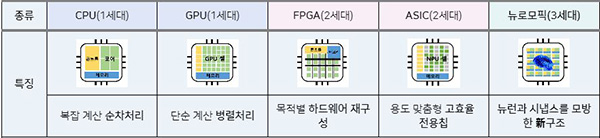
▲Semiconductor technology development stages (Photo: Patent Office official blog)
NPU optimized for AI algorithms… High performance and high energy efficiency
Intel , Nvidia , Google, etc. Global Big Techs Take the Lead in AI Market
Professor Oh Chul of the Korea Institute of Cervical Spine Research, “Expecting Korea’s Competitiveness in 3rd Generation New Morphic Semiconductors”
As AI services have rapidly expanded across our lives and industries, the amount of data that needs to be processed has increased exponentially, and AI semiconductors that will replace GPUs are emerging as a next-generation semiconductor industry.
AI semiconductors are non-memory semiconductors that perform large-scale calculations required to implement AI services at ultra-high speeds and low power. According to the Korean Intellectual Property Office and the Korea Institute for Industrial Economics and Trade, AI semiconductors can achieve AI computational power efficiency that is approximately 1,000 times higher than existing ones.
It is also called NPU (Neural Processing Unit) because it is an artificial intelligence semiconductor that imitates the neural network of the human brain. Like the brain, it learns and processes information on its own and is capable of simultaneous calculations.
■ Why AI semiconductors are in the spotlight… Differences between CPU, CPU, and NPU
Before AI semiconductors were developed, the core brain roles were played by the CPU (Central Processing Unit) and GPU (Graphics Processing Unit).
However, CPUs that process data sequentially and serially are not optimized for AI that requires large-scale parallel processing operations, resulting in inefficiency.
GPUs have emerged as an alternative, and GPUs capable of parallel processing of data have established themselves as one of the AI semiconductors.
Afterwards, semiconductors that maintained the parallel processing characteristics of GPUs but were made exclusively for AI emerged, such as NPUs in the form of FPGAs or ASICs.
FPGA (Field Programmable Gate Array) is characterized by high flexibility because the hardware inside the chip can be reprogrammed according to the purpose.
ASIC (Application Specific Integrated Circuit) is a type of circuit mainly developed by global IT companies, is manufactured for a specific purpose, and has high efficiency characteristics.
NPU can be optimized to take AI algorithms into account. In other words, it is optimized to process large-scale learning data and then extract inference results. In addition, high performance and high energy efficiency were achieved by considering the connection structure with the memory that stores intermediate data during the learning and inference process.
△ Facial recognition using deep learning △ Biometric authentication △ Voice recognition △ Intelligent Personal Assistant (IPA) As applications are increasingly being incorporated into smartphone functions, NPUs are being installed to efficiently process these applications. NPUs are also used in various industrial fields such as autonomous vehicles and cloud data centers.
By advancing NPU technology, we can advance to neuromorphic processor technology that enables information processing and recognition at the level of the human brain.
Neuromorphic semiconductors mimic the structure of nerve cells (neurons) and connections (synapses) found in the human brain. Computation, learning, and inference are possible on a single semiconductor, with no energy loss.
Although it is still not widely used, it is expected to be widely used in areas such as smartphones, data centers, self-driving cars, and the cloud, and is expected to receive attention in the future.
■ Global Big Tech Companies Create AI Semiconductors
Most companies currently operate AI data centers using GPUs, but interest in AI semiconductors is growing as they face the burden of operating costs due to issues such as rapid rises in GPU prices and power consumption.
According to the results of a study on the industrial competitiveness of AI semiconductors conducted by the Korean Intellectual Property Office and the Korea Institute for Industrial Economics and Trade in March, AI semiconductor patent applications worldwide have more than tripled from 2016 to 2019.
The major companies applying for patents by generation of AI semiconductors were Intel, IBM, and Samsung Electronics, which ranked at the top in all fields, and Samsung and SK Hynix ranked 2nd and 5th, respectively, in the next-generation neuromorphic field.
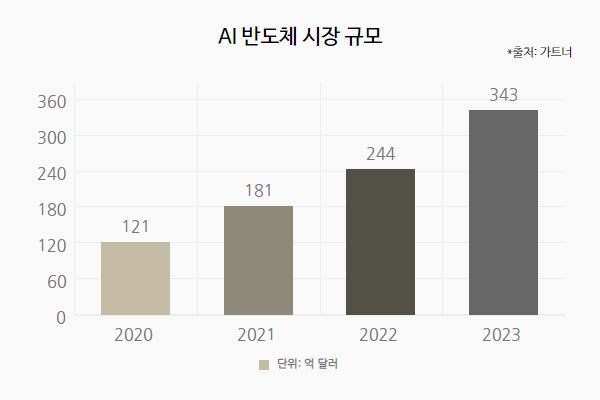
According to Gartner, the semiconductor market, which was worth about KRW 7.8 trillion in 2018, is expected to reach USD 34.3 billion (about KRW 40 trillion) in 2023 and account for 31.3% of the entire system semiconductor market in 2030.
Global big tech companies such as Qualcomm, Intel, Nvidia, SKT, Google, Amazon, Apple, and Tesla are jumping into the development of AI semiconductors.
Google has developed a Tensor Processing Unit (TPU), which It was first used in the 'AlphaGo Lee' version that faced Lee Sedol in 2016.
Last year, Samsung Electronics developed the world's first intelligent semiconductor equipped with an AI engine. In addition, a paper presenting a future vision for neuromorphic chips was published in the world-renowned academic journal 'Nature Electronics'.
SKT unveiled its 20-year-old AI semiconductor, 'SAPEON X220'. SKT announced that 'SAPEON' is 1.5 times faster than GPU in deep learning calculation speed, uses 80% of the power, and costs half the price of GPU.
KT also announced its goal of localizing GPU technology by collaborating with domestic fabless startups to produce dedicated AI semiconductor chips within 23 years.
Last year, Furiosa AI, a fabless startup specializing in AI semiconductors, attracted attention by demonstrating its competitiveness with Warboy, beating out Nvidia in the AI semiconductor performance competition MLPerf.
Founded in 2017, Furiosa AI is a company that has been developing the full stack required for high-performance AI semiconductor development for four years. It is evaluated as having competitiveness, as evidenced by business agreements with Naver and Kakao.
It appears that our government and companies need long-term investment to strengthen AI semiconductor competitiveness.
Professor Oh Chul of the Economic Pursuit Research Institute said, “In the rapidly changing global situation, such as the competition for technological hegemony surrounding semiconductors, we must pay more attention to the importance of AI semiconductor patents,” and “The relative advancement of our companies in third-generation neuromorphic semiconductors, which are likely to lead future technological innovation, is noteworthy.”
Kim Ji-soo, director of the Patent Examination Planning Bureau at the Korean Intellectual Property Office, said, “AI semiconductors are a key strategic field where artificial intelligence system semiconductors are converged, and are an essential industry closely linked to the success of carbon neutrality and the digital new deal,” adding, “We will establish a patent examination policy that can contribute to enhancing the competitiveness of the AI semiconductor industry.”
Comments
Related news
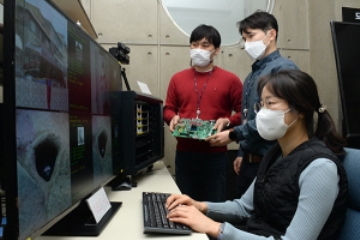
ETRI Distributes Core AI Semiconductor Software for Free
ETRI has developed and disclosed core technologies to shorten the development time and reduce costs for AI semiconductor design.
2022.02.03by 김예지 기자
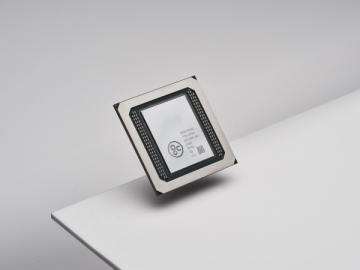
Graphcore Launches AI Semiconductor with TSMC 3D WoW Technology
AI semiconductor company Graphcore has unveiled the first artificial intelligence processor incorporating TSMC's 3D packaging technology, Wafer-on-Wafer (WoW), delivering 40% improved performance and 16% superior power efficiency compared to existing models.
2022.03.07by 강정규 기자
Chairman Choi Tae-won, “AI SK’s New Growth Engine”
SK Chairman Chey Tae-won emphasized the importance of SKT's next-generation AI services through discussions with AI business team members at SKT.
2022.03.15by 김예지 기자
NVIDIA Handles RTX GPUs' Challenging Workflows
Nvidia (CEO Jensen Huang), a leader in AI computing technology, has unveiled its latest RTX GPUs that support demanding workflows and hybrid work.
2022.04.04by 배종인 기자

SKT Restores Famous Overseas Content with AI 'Supernova'
SK Telecom has signed a business agreement to cooperate with Verimetrix on remasterin content business utilizing 'Supernova'.
2022.04.18by 김예지 기자











