


[Planning] Semiconductor Borigogae, “Turning Point in the First Half of 2023”
 Published2022.11.18 09:50
DRAM/NAND 1Q23 Lowest Point, Supply and Demand Expected to Improve in 2H20
As the semiconductor industry enters a down cycle, major manufacturers are continuing to reduce production and new investments. With this winter predicted to be a tough winter for the semiconductor industry, the first half of 2023 is expected to be a turning point for demand recovery and supply/demand improvement.
■ Major semiconductor manufacturers reduce supply and investment
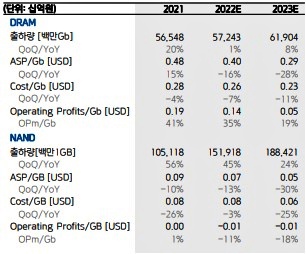
According to the semiconductor industry outlook report by Park Yu-ak, a researcher at Kiwoom Securities Research Center, presented at the 2023 Economic and Industrial Outlook Seminar recently hosted by the Federation of Korean Industries, the average selling price (ASP) of DRAM and NAND flash is expected to decline by 20% in the second half of this year, and the 2023 outlook also projects an ASP decline of 28% for DRAM and 30% for NAND compared to the previous year.
In line with this outlook, semiconductor manufacturers are also adjusting their production volumes.
SK Hynix, a company that is moving quickly, announced that it will reduce its investment by more than 50% in 2023. This means that in addition to new capacity investment, it will reduce investment in process conversion. In addition, the company plans to reduce production in its relatively low-profitability product lineup. This is analyzed as a move to adjust supply and demand through a certain amount of investment reduction and production cuts to counter the semiconductor downcycle.
Noh Jong-won, president of SK Hynix's business division, said the investment cuts were "on par with the industry's facility investment cuts during the last financial crisis in 2008-2009."
Micron also announced that it will reduce its wafer input for DRAM and NAND flash by 20% in 2023 compared to the June-August level this year, moving to clear its backlog of inventory. It is reported that it is considering additional investment reductions, going beyond the 30% reduction in facility investment announced last September.
In addition, Kioxia has also decided to reduce NAND wafer input at its Yokkaichi and Kitakami fabs in Japan by 30% starting in October.
Samsung Electronics is the only one that has refused to reduce investment and production, and is maintaining production on its own. In a recent conference call announcing the third quarter performance, Han Jin-man, Vice President of Samsung Electronics Memory Business Division, stated, “We are not considering artificial reductions, and there will be no reductions for short-term supply and demand balance.”
■ DRAM and NAND Year-end and New Year Barley Hill, Turnaround Starting in the First Half of Next Year
We expect the DRAM and NAND flash downcycle to bottom out in the first quarter of 2023 before the industry recovers. As the impact of inventory adjustments, coupled with the decline in smartphone sales, is expected to show signs of recovery through the end of the year and early next year, demand and sales for PCs and servers are also expected to rebound after inventory adjustments through the first half of next year.
According to the semiconductor industry outlook report by Kiwoom Securities Research Center, the smartphone market demand outlook update predicts that a resilient demand recovery will be possible when the economy stabilizes in 2023 after inventory normalization in the fourth quarter of 2022.
Smartphone sales are continuing to be sluggish compared to the strong demand for premium products, and distribution channels and Android smartphone manufacturers are undergoing intensive inventory adjustments. According to the report, “inventory issues are expected to continue until the second half of this year, but the intensity will gradually weaken as the year approaches.”
The end of this inventory adjustment is expected to be an inflection point in the first quarter of 2023. Memory semiconductor shipments are expected to return to normal through the first half of next year, and PC DRAM inventory is also expected to normalize starting from the first quarter of 2023.
Server DRAM demand is expected to temporarily decline in the fourth quarter of 2022 and the first quarter of 2023. Server ODMs are adjusting their inventory as the overbooking volume decreases due to the resolution of the shortage of parts supply.
In summary, the industry expects DRAM supply and demand to rebound after a decline at the end of the year and beginning of the next. However, manufacturers are expected to proceed with equipment setup only after improvements in market demand are visibly observed. Considering the lead time from setup to supplying the volume to the market, it is expected that actual shipments to the market will not increase until the second half of 2023.
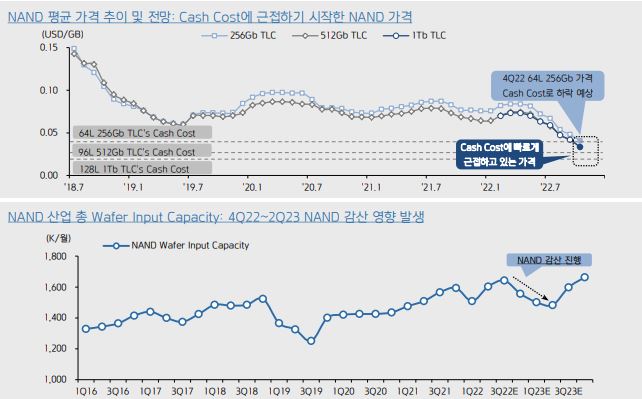
In the case of NAND flash, the inflection point is also expected to arrive sooner, as it showed a steeper decline than expected. Looking at the average NAND price trend, it is approaching the cash cost, so a decline is expected until the second quarter of 2023. According to the report, “If the price decline does not stop in the second quarter of 2023, we will consider a reduction in the 128L 1Tb product.”
However, considering the current price decline, NAND suppliers are expected to incur large losses, but like DRAM, they are expected to attempt a price rebound starting in the second quarter of 2023.
Do Hyun-woo, a researcher at NH Investment & Securities, said, “Even if demand is not good due to an economic downturn, if supply is reduced and supply falls short of demand, product prices will rise and corporate performance will improve.” He added, “It will take about six months from the start of production reductions until actual supply decreases, so supply and demand are expected to improve in the second quarter of 2023, and the memory industry is expected to improve starting in the third quarter.”

Comments
Related news
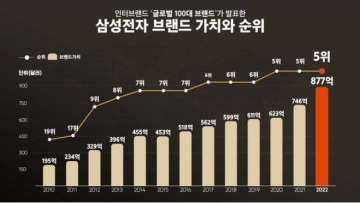
Samsung Electronics maintains its position in the world's top five with a brand value of $87.7 billion.
As global data usage has increased recently, semiconductor brand value has surged significantly, and Samsung Electronics has recorded double-digit growth for two consecutive years, further strengthening its position as a "Global Top 5" brand.
2022.11.04by 명세환 기자
ASML: "Korean Supply Chain Stabilization Begins in Full Swing"
ASML, the world's largest lithography equipment company known as a "super supplier" in the semiconductor industry, has begun full-scale investment in South Korea's semiconductor sector and taken its first step in establishing a supply chain ecosystem.
2022.11.15by 명세환 기자
Global semiconductor equipment companies actively engage in domestic R&D
ASML, a company that supplies global semiconductor exposure equipment, is accelerating investment in the construction of a domestic remanufacturing center and R&D center, while similar semiconductor equipment suppliers are actively expanding their domestic R&D operations during the same period.
2022.11.15by 명세환 기자

Intel Unveils Next-Generation 'Core Ultra Series 3' and vPro Platform for Enterprise PCs
Intel has officially unveiled the "Intel Core Ultra Series 3" for next-generation enterprise PCs and the latest vPro platform, addressing a wide range of demands from enterprise notebooks to high-performance workstations.
2026.03.26by 배종인 기자

ROHM Launches ESD Protection Diode Compatible with High-Speed Interfaces of 10Gbps or Higher
Semiconductor specialist ROHM has developed the 'RESDxVx series' of ESD (electrostatic discharge) protection diodes capable of responding to next-generation high-speed data communication environments exceeding 10Gbps, simultaneously enhancing both signal quality maintenance required in high-speed interfaces and IC protection performance.
2026.03.26by 배종인 기자











