



U.S. Unveils Guardrail Draft… China Criticizes “Blatant Protectionism”
 Published2023.03.23 10:21
China, “Leading Industrial Chain Decoupling, Allies Also Sacrificed”

▲ U.S. Commerce Secretary Gina Raimondo (Photo: U.S. Department of Commerce)
With the announcement of detailed regulations regarding the U.S. semiconductor guardrail, the industry breathed a sigh of relief as it is projected that production expansion through facility upgrades in China will be possible. China, however, raised its voice in criticism, claiming that it hinders the international industrial chain.
On the 21st, the U.S. government announced a draft of guardrail regulations that restrict the expansion of manufacturing facilities in countries of concern, such as China, for companies receiving subsidies through the Semiconductor Support Act (CHIPS and Science Act).
Companies receiving subsidies are restricted from expanding the production capacity of their facilities in countries of concern, such as China, by up to 5% over a 10-year period based on wafers. For legacy semiconductors, production capacity expansion is permitted up to 10%. This is defined as legacy semiconductors that include logic ICs of 28 nanometers or larger, and in memory, NAND flash of less than 128 layers or DRAM exceeding 18 nanometers.
In addition, provisions restricting technological cooperation were stipulated, limiting joint research and technology licensing with entities of concern within countries of concern, such as entities on the Industrial Security Administration's list and the Ministry of Finance's list of Chinese military-industrial complex companies. This means restricting the development, patents, and know-how related to technologies and items sensitive to national security.
In addition, the U.S. Department of Commerce announced that it would include semiconductors used in quantum computing, radiation-intensive environments, and specialized military sectors in its national security requirements. Along with this, it reported that it would further strengthen export controls implemented since last October.
■ Ministry of Trade, Industry and Energy, “Expansion and Upgrade of Facilities in China Possible”
On the 22nd, the Ministry of Trade, Industry and Energy explained regarding the U.S. Department of Commerce's draft guardrail that "expansion of facilities and technological improvement by our companies in China" is possible.
The Ministry of Industry stated that, following a review of the detailed regulations regarding guardrails, it is determined that domestic companies will be able to continue maintaining and partially expanding production facilities in China, as well as upgrading their technology. The Ministry projected that further production expansion would be possible depending on corporate strategies, as technology upgrades could increase the number of chips per wafer through higher integration density.
This is because the U.S. Department of Commerce uses the 'wafer' as the benchmark for defining production volume. It points out that there are no maintenance restrictions on existing facilities, and that production volume can be expanded without increasing wafer input through strategies such as yield improvement and high integration in patterning and packaging using next-generation equipment.
It is expected that technology and process upgrades for production facilities in countries of concern, including China, can continue if the facility expansion limits of 5% in advanced nodes and 10% in legacy processes are observed.
Consequently, domestic semiconductor companies affected by the U.S. Semiconductor Support Act and Guardrails, such as Samsung Electronics and SK Hynix, feel that the worst has been avoided. It has been reported that their position is to review the current draft and formulate a future response strategy.
The Ministry of Trade, Industry and Energy plans to meet with key working-level officials in charge of the U.S. Semiconductor Support Act who are visiting Korea on the 23rd to discuss detailed support plans for financial incentives and detailed regulations regarding guardrails.
■ China Criticizes U.S. Guardrails as Blatant Protectionism
China expressed strong opposition to the detailed guardrail regulations announced by the U.S. Department of Commerce.
Chinese Foreign Ministry Spokesperson Wang Wenbin condemned the U.S. "guardrails" at a regular press briefing on the 22nd, calling them "blatant technological blockades and protectionism." Wang stated, "The U.S. is leading an artificial decoupling of industrial chains by intimidating certain countries," adding that "the U.S. is sacrificing the interests of its allies for semiconductor hegemony."
On the same day, China’s Global Times cited expert opinions to argue that “China’s return of semiconductor manufacturing to the United States will not succeed, considering its better supply chain, lower costs, and status as the world’s largest semiconductor market.” It cited as an example the estimate that TSMC’s costs would increase by more than 50% when producing chips in the U.S. compared to Taiwan.
The domestic industry also predicts that operating a fab in the U.S. will incur higher operating costs than in the domestic environment. Cost increases are expected in areas such as local labor costs and the dispatch of domestic professional personnel, and there are also observations that high-tech personnel may not be as receptive to 24-hour day and night work as they are in China.
Nevertheless, given that the U.S., Japan, and the EU hold the lead in source technologies, advanced equipment, and materials, the prevailing view is that it will be difficult to prevent the United States, which acts as the central axis, from reshaping the semiconductor ecosystem.
The industry is closely watching to see how the final proposal will turn out following the 60-day comment period regarding the U.S. Department of Commerce's detailed regulations on guardrails.

Comments
Related news
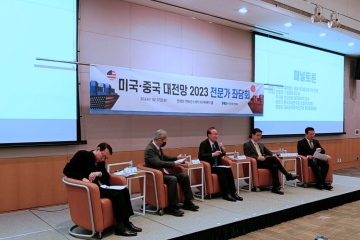
"US Containment of China: Opportunity Amidst Korea's Crisis"
A professor of Sungkyunkwan University's China Graduate School, Park Ki-soon, who attended an expert roundtable discussion hosted by the Korea Chamber of Commerce and Industry, noted that the conflict between the United States and China has contributed to maintaining South Korea's technological gap in the semiconductor industry. He indicated that technology suppression against China, which has continued since the Trump administration, has helped maintain the semiconductor gap.
2023.01.17by 명세환 기자
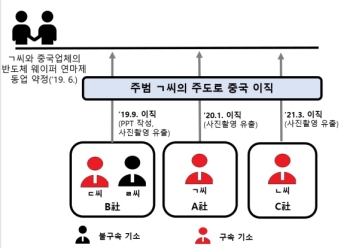
Semiconductor core technology leaks into China, causing damages in the hundreds of billions
Core technology related to semiconductor CMP processes was transferred to China, resulting in damage in the hundreds of billions of won, but our government's efforts prevented further losses.
2023.01.26by 배종인 기자
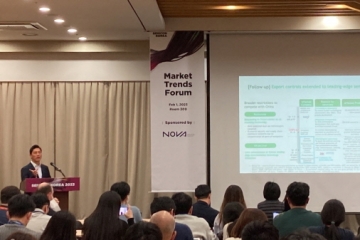
[SEMICON Korea 2023] "US to Continue Suspension of Semiconductor Export Controls to China"
Boston Consulting Group forecasts that the U.S. public export control moratorium will continue under current conditions, while analyzing that sustained business operations in China remain risky.
2023.02.02by 성유창 기자

Intel Unveils Next-Generation 'Core Ultra Series 3' and vPro Platform for Enterprise PCs
Intel has officially unveiled the "Intel Core Ultra Series 3" for next-generation enterprise PCs and the latest vPro platform, addressing a wide range of demands from enterprise notebooks to high-performance workstations.
2026.03.26by 배종인 기자

ROHM Launches ESD Protection Diode Compatible with High-Speed Interfaces of 10Gbps or Higher
Semiconductor specialist ROHM has developed the 'RESDxVx series' of ESD (electrostatic discharge) protection diodes capable of responding to next-generation high-speed data communication environments exceeding 10Gbps, simultaneously enhancing both signal quality maintenance required in high-speed interfaces and IC protection performance.
2026.03.26by 배종인 기자











