



Intel and OSC Double AI Processing with HPC Clusters
 Published2024.02.23 15:57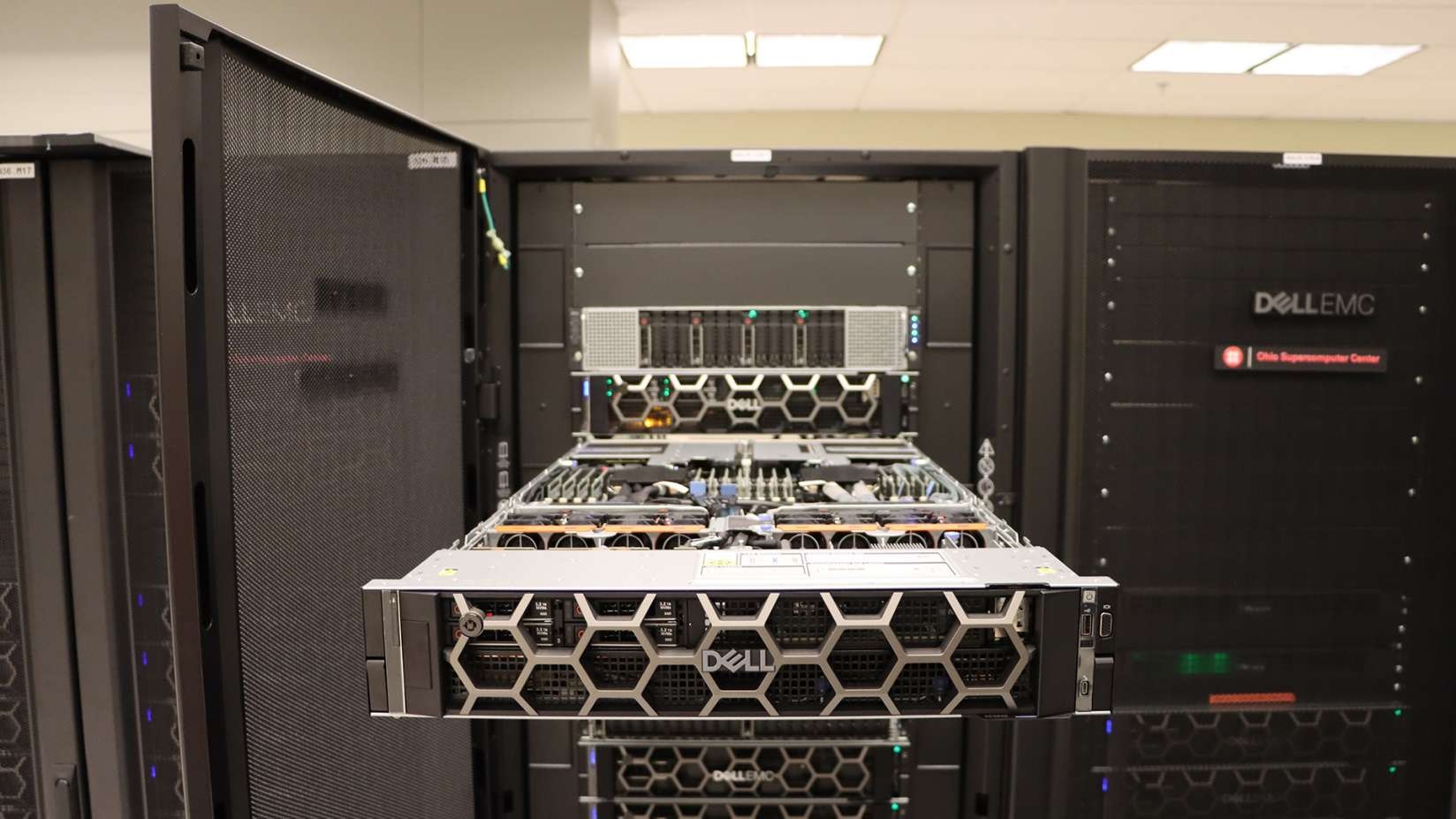
▲Intel-Ohio Supercomputer Center New HPC Cluster (Photo: Intel)
AI and machine learning are essential for solving complex research problems in science, engineering, and biomedicine. As the efficacy of these technologies continues to be proven, their use is also increasing in academic fields such as agricultural science, architecture, and sociology.
Intel announced on the 23rd that it has unveiled Cardinal, a cutting-edge high-performance computing (HPC) cluster in collaboration with Dell Technologies, NVIDIA, and the Ohio Supercomputer Center (OSC).
Cardinal is specifically designed to meet the growing demand for HPC resources in the region, particularly in the field of artificial intelligence (AI), along with research, education and industrial innovation.
Cardinal clusters have hardware that can meet the demands of growing AI workloads. In both functionality and capacity, this new cluster is expected to be a larger upgrade than the Owens Cluster it replaces, which was launched in 2016.
Cardinal Cluster is a heterogeneous system leveraging Dell PowerEdge servers and Intel® Xeon® CPU Max Series with High Bandwidth Memory (HBM) that serves as a foundation for efficiently managing memory-intensive HPC and AI workloads while promoting programmability, portability and ecosystem adoption.
△With 756 Max Series CPU 9470 processors providing a total of 39,312 CPU cores △128 gigabytes (GB) of HBM2e and 512 GB of DDR5 memory per node △With a single software stack and x86-based traditional programming model, this cluster can more than double the processing power of the OSC, addressing a wide range of use cases and supporting easy introduction and deployment.
Other key specs include: 104 cores across 32 nodes, 1 terabyte (TB) of memory, 4 x NVIDIA Hopper architecture-based H100 Tensor Core GPUs with 94 GB of HBM2e memory interconnected with four NVLink connections, 500 petaflops of peak AI performance (FP8 Tensor Cores including sparsity) for large-scale AI-based scientific applications with 400 Gbps of networking performance and low latency NVIDIA Quantum-2 InfiniBand, 104 cores across 16 nodes, 128 GB of HBM2e and 2 TB of DDR5 memory capable of handling large-scale symmetric multiprocessing (SMP) style workloads, etc. Includes.
“The Intel Xeon CPU Max series is the optimal choice for developing and deploying HPC and AI workloads leveraging the most widely adopted AI frameworks and libraries,” said Ogi Brkic, vice president and general manager of Intel’s Data Center AI Solutions product line. “The system’s unique heterogeneity will enable OSC’s engineers, researchers and scientists to take full advantage of the more than 2x memory bandwidth performance it delivers.”

Comments
Related news
Mouser is now stocking the Advantech VEGA-P110 PCIe Intel Arc A370M embedded GPU card.
Mouser Electronics, a globally authorized distributor of cutting-edge electronic components and industrial automation products, supplies Advantech's VEGA-P110 PCIe Intel® Arc A370M embedded GPU card.
2024.02.08by 배종인 기자

Hexagon, digital implementation of large ships and marine environments that are difficult to verify in real life
Hexagon Manufacturing Intelligence, a global leader in digital reality solutions combining sensors, software, and autonomous technologies, provided its dynamics simulation solution "Adams" to support research conducted by Professor Park Ji-hyuk's research team at Yeungnam University with financial support from the Korea Institute of Marine Science and Technology Promotion. The research focused on "Design and structural optimization of automatic mooring systems for 6,000-ton autonomous vessels."
2024.02.08by 배종인 기자
.jpg)
SkyChips Integrates Ceva Bluetooth IP into Electronic Shelf Label ICs
Global technology intelligence company ABI Research has projected that annual ESL market shipments will grow from approximately 185 million units in 2022 to approximately 560 million units by 2027. Accordingly, it is anticipated that Bluetooth-enabled electronic shelf labels (ESL) will capture a larger share across the overall market.
2024.02.14by 명세환 기자
Intel: "AI-accelerated PC supply will be a priority, with 100 million units to be delivered by next year."
Intel stated that AI represents a new opportunity for the PC industry, and that devices must be supplied in large quantities as a priority for AI advancement. The company announced that it will make every effort to ensure sufficient product supply to deliver approximately 100 million devices by next year.
2024.02.19by 배종인 기자
Intel Launches Systems Foundry...1nm Shipments in 2025
The advanced semiconductor foundry market is prepared to expand from a two-way competition into a three-way battle. Intel has launched a full-fledged systems foundry business, revealing ambitions to establish ecosystem leadership by leveraging advanced process nodes and cutting-edge packaging technologies.
2024.02.22by 권신혁 기자











