



[2025 e4ds Tech Day] "MCU-Based On-Device AI, Realized with 'TinyML' and Generative Platforms"
 Published2025.10.20 11:33
.jpg)
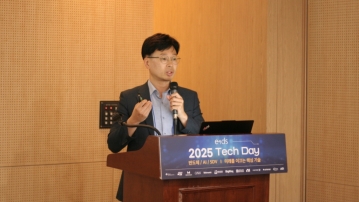
▲MDS Tech's Taejun Park is presenting a development solution that breaks down barriers to entry into on-device AI.
Implement algorithms directly and easily develop models without AI expertise.
Advances in TinyML and generative platforms are significantly lowering the barrier to MCU-based AI development.
At the '2025 e4ds Tech Day' event held on September 9, MDS Tech's Taejun Park presented 'Development Solutions to Break Down Entry Barriers to On-Device AI', and explained in detail the definition, advantages, market outlook, and changes in the development environment of on-device AI.
Cloud-based AI is suitable for large-scale computations, as it transmits data collected from devices to a cloud server for processing and then returns the results to the device. However, it requires a stable network connection and has limitations in terms of real-time performance and privacy protection.
On the other hand, on-device AI is an AI model that is installed inside the device and performs analysis and inference locally without sending data externally.
Park Tae-jun emphasized, “On-device AI can perform real-time analysis without an internet connection, and it is optimized for battery-powered devices as it operates at low power and low cost.”r />
In particular, it is said to be strong in real-time processing by utilizing dedicated hardware such as MPU (Machine Processing Unit) and DSP (Digital Signal Processor), and is more competitive than cloud-based AI in terms of security and strategy.
The market outlook is also bright.
“The on-device AI market is expected to grow by more than 20% annually to reach approximately $39.5 billion by 2033,” said Park Tae-jun, adding, “The shift from cloud-centric AI to on-device-centric AI is accelerating.”
In fact, on-device AI is being applied to various products, such as Samsung's Galaxy S25 and Incheon Airport's guide robot, and Apple's delay in implementing AI functions is a clear example of the importance of technological competitiveness.
On the other hand, there are high barriers to entry in on-device AI development.
Representative Park Tae-jun cited complex and isolated development environments, the difficulty of creating lightweight models, the burden of hardware-specific code optimization, and the complexity of model updates as key challenges.
In particular, while there was a strong perception that high-performance hardware and large-scale infrastructure were essential in the past, it is noteworthy that on-device AI implementation has recently become possible even on 32-bit MCUs (Microcontroller Units).
At its core is "TinyML," an ultra-small machine learning technology capable of executing AI models with memory ranging from tens of kJ to several kJ and power consumption in the milliwatt range. It is suitable for MCU environments because it reduces memory usage based on integer operations and enables local inference without an Internet connection.
Mr. Park introduced major TinyML generation platforms such as Edge Impulse, SensiML, Neuton, and DeepCraft, and emphasized the market interest by showing the background of their acquisition by chip manufacturers.
These platforms provide a one-stop solution for everything from data collection to labeling, feature extraction, training, validation, optimization, and deployment, making it easy to develop models without AI expertise.
In particular, ARM's development environment, 'Keil MDK', supports more than 11,000 Cortex-M-based MCUs and enables efficient development through the CMSIS-NN neural network library and high-performance ARM compiler.
Representative Park Tae-jun explained, “Compared to GCC, the ARM compiler is 20% faster in execution speed and 5% smaller in code size, so we can expect to see a reduction in mass production costs.”
He also said, “Now, you can automatically create and deploy models by simply defining data collection without having to implement complex algorithms yourself,” adding, “This is the beginning of an era where developers can implement AI more quickly and efficiently.”

Comments
Related news
[2025 e4ds Tech Day] "High-Speed Interface and Measurement Technology: Core Competitive Edges of Future Mobility"
Park Young-jun, Executive Director of Tektronix, presented on "Verification for Automotive High-Speed Data Communication Technology and Power System Design" at the '2025 e4ds Tech Day' event. Executive Director Park stated, "Extending beyond 100Base-T1 and 1,000Base-T1 to 10Base-T1, all in-vehicle communication will be integrated into a single protocol," and emphasized that to ensure the reliability of high-speed interfaces, simulation-based eye diagram analysis using oscilloscopes is necessary beyond simple probing, and highlighted the importance of advanced measurement tools such as Tektronix's Serial Data Link Analyzer.
2025.09.19by 배종인 기자
[2025 e4ds Tech Day] "ADI GMSL Solutions: A Core Infrastructure for the SDV Era"
ADI (Analog Devices Inc.) Executive Director Son Sung-ho presented on "High-Speed Data Transmission Technology for SDV - ADI GMSL" at the '2025 e4ds Tech Day,' providing detailed information on SDV architecture and how ADI's GMSL (Gigabit Multimedia Serial Link) solution is applied within it. Executive Director Son Sung-ho stated, "The automotive industry is undergoing rapid paradigm shifts. There is accelerating transition away from traditional hardware-centric vehicle design toward software-centric 'Software Defined Vehicle (SDV)'" and added, "Within this trend, ADI is leading core technologies in future mobility through high-speed interface solutions optimized for the SDV era."
2025.09.19by 배종인 기자
.jpg)
[2025 e4ds Tech Day] "Power Innovation in the AI Era: Improving Efficiency at Every Power Conversion Stage and Reducing Overall Losses Urgently"
Infineon Technologies Executive Vice President Kim Yong-jin presented at the '2025 e4ds Tech Day' event held on the 9th, speaking on the topic of "Infineon's Next-Generation Power Semiconductors for Energy-Efficient Power Management Solutions in AI Data Centers." He stated, "To achieve power innovation in the AI era, it is urgent to reduce overall losses by improving efficiency at each stage of the power conversion structure." To this end, he emphasized wide bandgap devices such as silicon carbide (SiC) and gallium nitride (GaN) as the core solution.
2025.09.26by 명세환 기자
.jpg)
[2025 e4ds Tech Day] "SiC Market to Grow Dozens-Fold by 2034, Requires Stabilization of Supply Chain and Domestic Mass Production Infrastructure."
Kim Hyung-woo, Director of the Next-Generation Semiconductor Research Center at Korea Electrotechnology Research Institute (KERI), presented on "Domestic and International Technology and Market Trends for SiC-Based Power Semiconductors" at the '2025 e4ds Tech Day' event held on September 9th. According to Director Kim Hyung-woo, silicon carbide (SiC) is establishing itself as a key material in the high-voltage, high-temperature, and high-reliability power electronics field due to its wide bandgap and excellent thermal conductivity.
2025.09.26by 배종인 기자
.jpg)
[2025 e4ds Tech Day] "GaN, the Future of Power Semiconductors, is Ready for Commercialization in 48V Power Systems."
Texas Instruments (TI) Manager Kim Seung-mok presented on the topic of "Implementing High Power Density and Efficient Digital Power Systems with TI GaN FET" at the '2025 e4ds Tech Day' event held on September 9th, emphasizing that power semiconductors are the core of next-generation industries such as electric vehicles, renewable energy, and high-efficiency power supplies. Manager Kim Seung-mok first reviewed the evolution of power semiconductors, stating, "Until 20 years ago, IGBTs were mainstream, but with the emergence of SiC, it began to be applied to high-voltage systems above 1,200V. However, there were limitations in terms of switching frequency. In contrast, GaN can switch up to 12MHz at voltage levels of 600-650V, making it possible to dramatically increase power density."
2025.09.29by 배종인 기자











