



SK Chairman Chey Tae-won: "We will solve AI bottlenecks with memory, infrastructure, and solutions."
 Published2025.11.03 14:23
.jpg)
▲SK Group Chairman Chey Tae-won delivers a keynote speech on the topic of 'AI Now & Next' at the 'SK AI Summit 2025.'
Fully autonomous production using digital twin technology in the memory production process
"We will address the supply-demand imbalance that hinders the spread of AI through memory semiconductors, AI infrastructure, and AI utilization."
SK Group Chairman Chey Tae-won delivered a keynote speech on the topic of “AI Now & Next” at the “SK AI Summit 2025,” Korea’s largest AI event held at COEX in Seoul on the 3rd, and presented SK’s vision and implementation strategy to respond to the surge in AI demand.
Chairman Choi Tae-won cited the following as key factors driving the increase in demand for AI: the full-scale adoption of inference, the introduction of AI in business-to-business (B2B) transactions, the proliferation of agents, and state-led competition for sovereign AI.
In particular, he explained, “Computing demand is rapidly increasing in the inference process where AI thinks and verifies on its own, and explosive growth is expected in the B2B market, which prioritizes competitiveness over cost.”
Chairman Choi Tae-won said that SK will focus on three areas to solve the problem of 'supply-demand mismatch', which is an obstacle to the spread of AI: △memory semiconductor supply △AI infrastructure construction △AI technology developmentIt suggested the active use of alcohol.
“AI is shifting its paradigm from a technological competition to a competition of efficiency, and SK will continue to design efficient AI solutions together with its customers,” he said.
Chairman Choi Tae-won said that while AI chip performance is improving every year, the speed of memory supply is not keeping up, and that “we have entered an era of supply bottlenecks.”
Chairman Choi Tae-won said, “SK Hynix has received a request from OpenAI to supply 900,000 HBM wafers per month, and to this end, we will expand supply through the M15X fab in Cheongju and the Yongin Semiconductor Cluster, which is scheduled to begin operation in 2027.”
The Yongin cluster is expected to have production capacity equivalent to 24 M15X fabs.
SK is also accelerating the construction of optimal AI infrastructure that can maximize AI chip and memory performance.
Representative examples include the 'Haein' cluster built by SK Telecom and the Ministry of Science and ICT in Guro, Seoul, the Ulsan AI Data Center in collaboration with AWS, and the Southwest AI DC being promoted with OpenAI.
Chairman Choi stated, “SK is directly providing everything from semiconductors to power and energy solutions, and is seeking the most efficient AI infrastructure structure.”
Chairman Choi introduced the 'AI Factory' project, which is in collaboration with NVIDIA, and said, "We will achieve complete autonomy by applying digital twin technology to the memory production process."
SK Hynix is building a virtual factory using NVIDIA GPUs and digital twin solutions, simultaneously pursuing manufacturing efficiency and quality improvements.
SK Telecom launches business AI agent ‘Adot Biz&rsquWe are developing AI tools that can be applied in real-world work through o; and plan to open these tools to external companies to contribute to increased productivity. Automation and virtualization through AI are becoming core pillars of SK's AI strategy.
During the keynote, video messages from Amazon CEO Andy Jassy and OpenAI CEO Sam Altman were shown. Jassy praised SK as "a leading partner for expanding Amazon's AI solutions," while Altman emphasized, "Infrastructure partnerships like SK's are essential for the continued use of AI."
Chairman Choi stated, "AI is not something we can tackle alone. SK will not compete with our partners, but will design and develop solutions together." He added, "SK will build a 'Korean AI ecosystem' encompassing semiconductors, infrastructure, and models to support our strategy of becoming one of the top three AI powerhouses."

Comments
Related news
SK Expands AI Ecosystem with NVIDIA, Including HBM4 and AI Factory
SK Group is partnering with NVIDIA to build a "Manufacturing AI Cloud" that will lead the digital transformation of Korea's domestic manufacturing ecosystem. This is Asia's first commercialization case of a Manufacturing AI Cloud utilizing NVIDIA's Omniverse platform, and it will be opened to domestic startups and public institutions to foster a manufacturing AI ecosystem.
2025.11.03by 명세환 기자
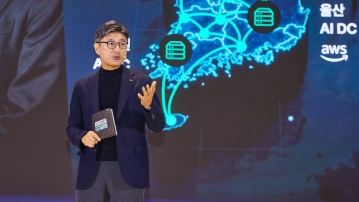
SKT CEO Jeong Jae-heon: "As Korea's leading AI provider, we will dedicate ourselves to becoming one of the top three AI powerhouses."
Jung Jae-heon, CEO of SK Telecom, announced an AI infrastructure construction roadmap at the 'SK AI Summit 2025' held on the 3rd, presenting a vision to strengthen South Korea's AI competitiveness as the nation's representative AI business operator. Through a keynote speech, CEO Jung unveiled the 'AI Infra's Now & Next' strategy, which includes expansion of the Ulsan AI Data Center (DC), establishment of a manufacturing AI cloud, and technology collaboration in edge AI and AI-RAN.
2025.11.03by 배종인 기자
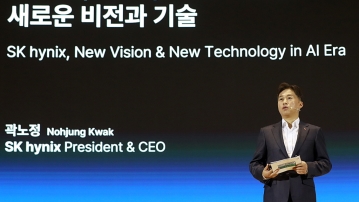
Kwak No-jeong, CEO of SK Hynix, said, "As a 'full-stack AI memory creator,' we will deliver value that exceeds customer expectations."
SK Hynix CEO Kwak No-jung announced a new vision to lead the AI era, "Full Stack AI Memory Creator," at the 'SK AI Summit 2025' held on the 3rd, presenting the future direction of the global memory market. CEO Kwak No-jung stated, "So far, SK Hynix has played the role of a 'Full Stack AI Memory Provider,' supplying products that customers want in a timely manner," and emphasized, "Going forward, we will evolve into a creator that creates AI memory as a co-architect and eco-contributor."
2025.11.03by 명세환 기자

[e4ds Tech Day 2026 ⑨] Sim Sang-gyu, Autocrypt CTO: "In the Physical AI Era, Automotive Security Must Extend Beyond the Vehicle"
At e4ds Tech Day 2026, Sim Sang-gyu, CTO of Autocrypt, explained automotive cybersecurity strategies in the era of Physical AI and SDV (Software-Defined Vehicle). Automobiles are evolving as part of an ecosystem connected to AI, cloud, chargers, IoT, and robots, and he emphasized that the scope of security must expand beyond the vehicle interior to the entire connected environment. In particular, AI model tampering, adversarial attacks, OTA updates, and EV charger hacking were identified as major threats. He explained that response measures require zero trust, AI model integrity protection, intrusion detection, Security by Design and Default, and full lifecycle security management, and that proactive security system establishment beyond regulatory compliance is critical for securing future mobility competitiveness.
2026.10.12by 배종인 기자
NVIDIA to Invest $1 Billion in U.S. Science Over Next Five Years
NVIDIA has announced plans to invest $1 billion over the next five years to strengthen U.S. scientific and technological competitiveness. The company will enhance cutting-edge artificial intelligence research and development capabilities in key areas including quantum computing, healthcare, and energy security, while expanding support for higher education research institutions and cloud service providers. NVIDIA is participating as a major industry partner in the White House Office of Science and Technology Policy's Genesis Mission, and is promoting supercomputer construction in collaboration with national laboratories including Argonne and Los Alamos.
2026.10.12by 배종인 기자











