



AM26 MCU-Based Ethernet Ring Architecture Key to Automotive Zone Architecture Innovation
 Published2025.11.21 10:28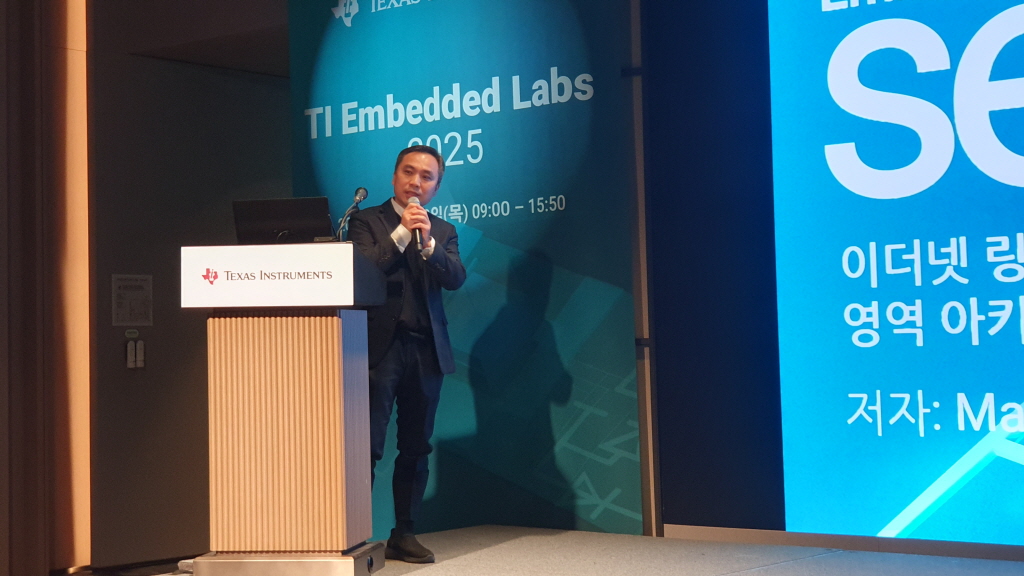
▲TI Director Park Seong-il is giving a presentation on the topic, “Simplifying Zone Architecture with Ethernet Ring Architecture Design Using AM26 MCUs.”
Weight reduction of more than 30% compared to existing star structures, minimizing data transmission delay.
“The future of the automotive industry is being reshaped around software and networks. The Ethernet ring architecture utilizing AM26 MCUs is an innovative solution that reduces the complexity of zone architectures and significantly improves the efficiency and safety of in-vehicle networks.”
Texas Instruments (TI) held 'TI Embedded Labs 2025' at the Westin Seoul Parnas on the 20th.
At the technology presentation that day, TI Director Park Seong-il presented on the topic of 'Simplifying Zone Architecture by Designing Ethernet Ring Architecture Using AM26 MCU'.
As the automotive industry rapidly changes, the hottest topic in the industry these days is Software Defined Vehicle (SDV) and the zonal architecture for implementing it.
Especially in the SDV era, efficient and secure network design is essential.
Regarding this, Director Park Seong-il said, “Recently, the industry is using the AM26 MCU for Ethernet ring arrays.“Keytecture is attracting attention as a solution that dramatically reduces the complexity of zone architecture,” he said.
Director Park Seong-il said, “The existing domain architecture required multiple MCUs for each function and a complex wiring network,” adding, “This resulted in various problems such as increased vehicle weight, higher costs, and difficulties in maintenance.”
He also said, “Zone architecture aims to solve this problem by dividing the vehicle into physical areas and controlling all functions in each area in an integrated manner,” adding, “On the other hand, high-performance MCUs and efficient networks are essential for area-specific control.”
Regarding this, Director Park Seong-il stated, "The AM26 MCU has a built-in Ethernet switch (CPSW), allowing each zone controller to function as a network router. In an Ethernet ring structure, the central processing unit (CCU) and each zone controller are connected in a ring shape, transmitting data in both directions."
According to Director Park Seong-il, the key advantage of this structure is natural redundancy, as data is transmitted in both directions, so even if one network is down, communication can continue through another route.
Additionally, it can reduce wiring weight by more than 30% compared to the existing star structure, and minimize data transmission delay by utilizing the hardware acceleration function (CPSW) of the AM26 MCU.
Additionally, the network structure has been simplified, enabling rapid response in the event of a failure.
The actual implementation of the AM26 MCU-based Ethernet ring architecture is designed with area-specific controller placement, Ethernet ring network configuration, central processing unit integration, and edge node management.
First, divide the vehicle into 3 to 4 zones, and install a zone controller equipped with an AM26 MCU in each zone. Next, connect each zone controller to an Ethernet ring to allow data to flow in both directions.
Additionally, major systems such as ADAS and IVI are integrated and managed by the CCU, and real-time data is exchanged with each zone controller.
Edge nodes, such as sensors and actuators, are directly connected to the zone controller and efficiently controlled, and utilize the CPSW function to maximize network performance, including packet replication, deduplication, and latency reduction.
Director Park Sung-il stated, "Some automakers are already adopting AM26 MCU-based Ethernet ring architectures, significantly reducing vehicle weight and costs." He added, "This is particularly advantageous for implementing future vehicle services such as over-the-air updates, real-time safety control, and high-performance infotainment. This architecture will become the standard after 2030."

Comments
Related news

“The Future of Autonomous Driving Depends on Semiconductor Technology”
Today's automotive industry is evolving beyond being simply a means of transportation into a comprehensive collection of cutting-edge technologies. In particular, the proliferation of ADAS (Advanced Driver Assistance Systems) functions is serving as a full-scale turning point toward the autonomous driving era, with semiconductor technology at its core. According to Texas Instruments (TI), semiconductors are a key element enabling vehicle sensing, processing, communication, and power management, with their importance growing to the point where 1,000 to 3,500 units are now mounted in a single vehicle.
2025.07.23by 명세환 기자

TI's predictive battery management technology extends electronic device operating time by up to 30%.
Texas Instruments (TI) has officially announced the launch of single-chip battery fuel gauges 'BQ41Z90' and 'BQ41Z50' with the Dynamic Z-Track™ algorithm applied. These products feature embedded high-precision predictive modeling algorithms capable of accurately measuring state of charge (SOC) and state of health (SOH) with error margins within 1%, and provide an effect of extending battery operating time by up to 30%.
2025.07.30by 배종인 기자
"Communication errors between different grounding and voltage domains solved with a single chip."
As low-voltage modular systems become increasingly prevalent, the risk of communication errors between different ground and voltage domains has risen. Texas Instruments (TI) recently introduced the '±80V ground level translator' through a Technical Article. This product reliably transmits signals between low-voltage systems with voltage levels of 1.71V to 5.5V while capable of handling maximum ±80V DC ground offset and eliminating up to 140Vpp AC noise at 1MHz.
2025.08.05by 배종인 기자
.jpg)
[2025 e4ds Tech Day] TI Vice President Seungmok Kim: "GaN Automotive Power Systems Open New Possibilities"
As automotive power systems rapidly evolve, GaN (Gallium Nitride) solutions are gaining attention as next-generation automotive power semiconductors, moving away from the previous trend of utilizing silicon (Si) semiconductors in the low-voltage range and silicon carbide (SiC)-based semiconductors in the high-voltage range. GaN provides optimal efficiency in the 200–500V power supply range and enables wide power scaling from 50W to 25kW, allowing simultaneous realization of both power density and system miniaturization. Recently, GaN applications are expanding even in low-voltage systems of 200V or below, making it possible to select the optimal device according to design requirements. In this context, Texas Instruments will participate in the '2025 e4ds Tech Day' event on September 9th to present on the topic of 'Implementing High Power Density and Efficient Digital Power Systems with TI GaN FETs.' We have arranged an interview with Kim Seung-mok, Section Chief at TI, who will be giving the presentation, to learn more about TI's GaN devices.
2025.08.28by 명세환 기자
.jpg)
[2025 e4ds Tech Day] "GaN, the Future of Power Semiconductors, is Ready for Commercialization in 48V Power Systems."
Texas Instruments (TI) Manager Kim Seung-mok presented on the topic of "Implementing High Power Density and Efficient Digital Power Systems with TI GaN FET" at the '2025 e4ds Tech Day' event held on September 9th, emphasizing that power semiconductors are the core of next-generation industries such as electric vehicles, renewable energy, and high-efficiency power supplies. Manager Kim Seung-mok first reviewed the evolution of power semiconductors, stating, "Until 20 years ago, IGBTs were mainstream, but with the emergence of SiC, it began to be applied to high-voltage systems above 1,200V. However, there were limitations in terms of switching frequency. In contrast, GaN can switch up to 12MHz at voltage levels of 600-650V, making it possible to dramatically increase power density."
2025.09.29by 배종인 기자











