



TI Launches System-Level Solutions Strategy for the Robotics Market
 Published2026.02.09 16:20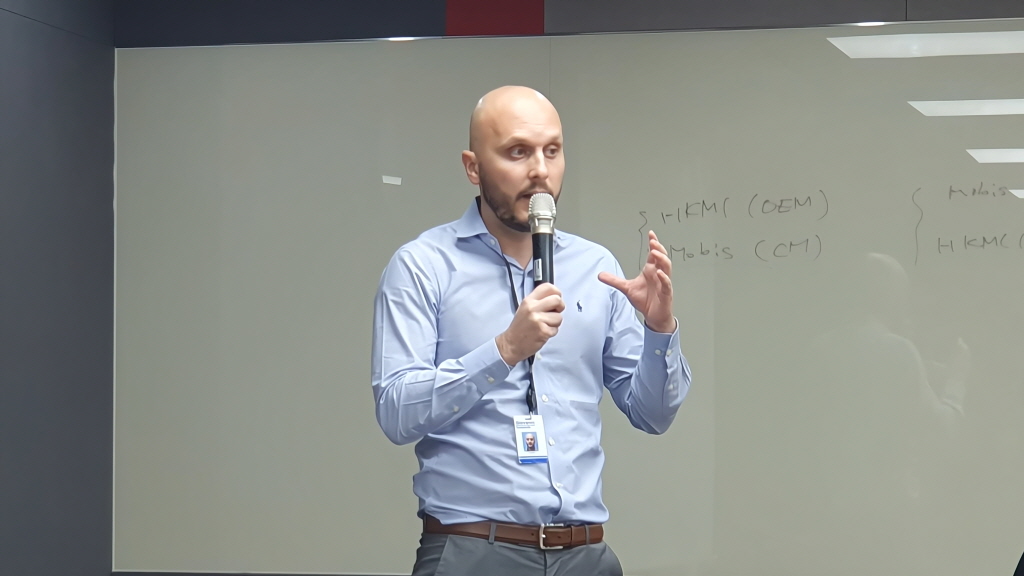
Giovanni Campanella, General Manager of Industrial Automation and Robotics at TI
Korea's robotics competitiveness is growing, with close collaboration not only with OEMs but also with Tier 1 sensors and actuators.
Texas Instruments (TI) has identified the robotics market as a key next-generation growth area and is launching a strategy of "system-level" solutions beyond individual semiconductor components.
On the 9th, TI held a press conference at the TI Korea office in Seoul, and Giovanni Campanella, General Manager of Industrial Automation and Robotics, visited Korea in person to reveal the changes in robotics technology and TI's product and policy direction in response to them.
Campanella explained the evolution of robotics as a flow from industrial robots to collaborative robots, service robots, and recently, humanoid robots that are attracting attention.
He emphasized, “In the past four to five years, humanoids have rapidly expanded into general-purpose robots that can be used in various environments such as factories, logistics, and homes,” and “In this process, mobility, sensing, computation, communication, functional safety, and AI have emerged as key technological elements.”
TI responds to these needs with motor control, power semiconductors, sensors, and MCU provides robot-specific reference designs based on its portfolio encompassing communication ICs.
In particular, we have put forward highly integrated and high-efficiency solutions targeting areas with extreme space constraints, such as humanoid joints and fingers.
A representative example is gallium nitride (GaN)-based power semiconductors.
TI explained that GaN has distinct advantages over silicon in terms of power density, heat dissipation, and size in humanoid joints that require 48V, 1kW power rails.
In fact, considering the effect of reducing passive components due to increased switching frequency, the overall solution size can be reduced by up to 50%.
In the sensing field, radar was presented as a key differentiating factor.
While cameras are vulnerable to lighting and weather, radar can detect dark environments and hidden objects, significantly improving the robot's cognitive abilities and safety.
TI emphasized a structure that precisely recognizes the 'safety bubble' around the robot through sensor fusion that combines radar and cameras.
In terms of communications, we are strategically pushing Single Pair Ethernet (SPE) to reduce wiring complexity.
It is evaluated that it can simultaneously solve the problems of weight and space inside the robot by supporting various data speeds from 10 Mbps for sensors to 100 Mbps for motor control while reducing the number of wires by half compared to existing Ethernet.
Industrial communication technologies such as EtherCAT and CAN are also provided here.
Functional safety is also one of the core policies emphasized by TI.
Functional safety, which ensures that the robot stops safely even if the motor or power source fails, is considered a factor that determines the commercialization of humanoids.
br /> TI announced that its battery management solution, including battery monitoring and protection ICs, fuel gauges, and charger ICs, precisely tracks voltage, current, and temperature, and predicts remaining usage time to ensure stable operation until the last moment.
The Korean market was evaluated as having a very high level of technology.
“Korea is highly competitive in the robotics field thanks to the technology it has accumulated in the automotive industry and its recent active investment in humanoids,” said Campanella. “TI is working closely with not only OEMs but also Tier 1 companies that handle sensors and actuators.”
Robotics is currently classified as an industrial sector within TI, but given its significant growth potential, the company plans to continue expanding strategic investment and support.
“TI plans to significantly shorten customers’ initial development time by expanding its robot-specific exhibits and reference designs in the future, and accelerate its conquest of the robotics market with system solutions that integrate power, sensing, and communications,” said Gampanella.

Comments
Related news
.jpg)
[2025 e4ds Tech Day] "GaN, the Future of Power Semiconductors, is Ready for Commercialization in 48V Power Systems."
Texas Instruments (TI) Manager Kim Seung-mok presented on the topic of "Implementing High Power Density and Efficient Digital Power Systems with TI GaN FET" at the '2025 e4ds Tech Day' event held on September 9th, emphasizing that power semiconductors are the core of next-generation industries such as electric vehicles, renewable energy, and high-efficiency power supplies. Manager Kim Seung-mok first reviewed the evolution of power semiconductors, stating, "Until 20 years ago, IGBTs were mainstream, but with the emergence of SiC, it began to be applied to high-voltage systems above 1,200V. However, there were limitations in terms of switching frequency. In contrast, GaN can switch up to 12MHz at voltage levels of 600-650V, making it possible to dramatically increase power density."
2025.09.29by 배종인 기자
TI Strengthens High-Precision Digital Lithography Technology for Advanced Packaging
Texas Instruments (TI) has launched the DLP991UUV, a new digital micromirror device (DMD) for next-generation digital lithography technology, strengthening high-precision digital lithography capabilities for advanced packaging.
2025.10.02by 명세환 기자
.jpg)
TI Unveils Next-Generation Scalable Power Management Solution to Meet AI Data Center Power Demands
Texas Instruments (TI) announced a new power management solution for AI data centers at the Open Compute Summit (OCP) held in San Jose, USA. The announcement focused on implementing a scalable power architecture ranging from 12V to 48V and up to 800VDC in response to growing AI computational demands.
2025.10.14by 배종인 기자

Data Center Power: 800V High-Voltage DC Architecture Is the Answer
With the explosive growth of the AI and server markets, power demand in data centers is surging from 100kW per rack to over 1MW, pushing the existing 48V power infrastructure to its limits. In response to these challenges in data center power delivery, Texas Instruments (TI) is actively addressing the issue with an 800V high-voltage DC architecture.
2025.11.04by 배종인 기자
.jpg)
TI CEO Park Joong-seo: "Embedded innovation through more products, innovation, and expanded production capacity."
Texas Instruments (TI) held 'TI Embedded Labs 2025' on the 20th at the Westin Seoul Parnas, unveiling innovative technologies and product portfolios in the embedded systems field, with a focus on how TI is addressing the latest trends including SDV, AI, radar, and wireless connectivity. In his keynote address, Park Joong-seo, President and Representative Director of TI Korea, stated that alongside technology development tailored to market demands, TI is actively expanding internal capacity through expanded global manufacturing facilities to ensure supply chain stability.
2025.11.20by 배종인 기자











