



“AI Now Moves”… 'e4ds Physical AI Frontier 2026' March 6, COEX
 Published2026.02.24 14:28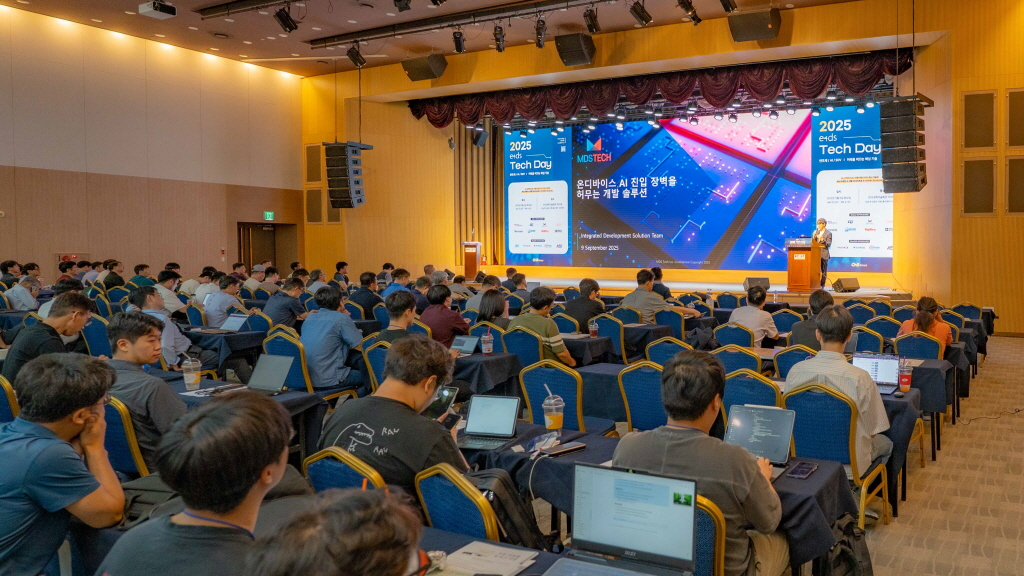
▲ A view of the 2025 e4ds Tech Day, a specialized tech conference (Photo: e4ds news)
The center of gravity of AI technology is shifting beyond cloud-based software competition to 'Physical AI,' which designs and verifies real-world physical behavior.
The 'e4ds Physical AI Frontier 2026' conference, which surveys these trends of change, will be held on March 6 at Rooms 317 and 318 of COEX in Samseong-dong, Seoul.
This event is the largest specialized physical AI conference in Korea, focusing on the implementation of AI that actually operates in industrial settings, such as sensors, semiconductors, embedded systems, robots, and manufacturing automation.
It redefines AI from a systems engineering perspective, encompassing everything from sensor signal quality to on-device inference, real-time control, and verification of power, latency, and stability, rather than a simple competition in algorithm performance.
Physical AI refers to an integrated architecture where sensors recognize physical signals, chips such as MCUs, NPUs, and APUs infer the data locally in real-time, and then verify the operation of actuators and motors through a control loop.
In this process, signal matching, noThe balance between product execution variables such as latency suppression, memory footprint, latency, power budget, and interface compatibility acts as quality competitiveness.
In the keynote speech, Lee Soon-youl, President of the Korea Industry 4.0 Association, presents implications for practical application in industrial settings, while Matteo Maravita, Center Director at STMicroelectronics, discusses the potential for implementing embedded AI and sustainable generative AI.
The afternoon event is divided into Track 1 and Track 2.
Track 1 focuses on strategies for applying physical AI in industrial settings, market trends, safety technologies, and case studies of collaborative robots and manufacturing automation.
Choi Hong-seop, CEO of Maum AI, will present the physical AI value chain and South Korea's strategy, while Kim Hwi-yeon, CSO of Safetics, will discuss technical responses to ensure the safety of robots and physical AI. Dobot Robotics CEO Lee Nae-hyeong introduces a new paradigm of manufacturing automation created by collaborative robots and physical AI.
Track 2 covers key elements of technology implementation, such as embedded semiconductors, on-device AI, simulation-based reinforcement learning, model lightweighting, and high-speed interconnects.
ETRI Division Head Jeong Young-jun surveys the present and future of physical AI through examples of quadruped robots and wearable suits, while Qualitas Semiconductor Executive Director Kim Jae-young emphasizes the importance of high-speed interface technologies such as UCIe, PCIe, and MIPI.
An official from e4ds stated, “This conference presents a ‘methodology for completing physical AI into products and services’ rather than treating it as a research concept,” adding, “It will serve as a practical benchmark for developers and companies aiming to make AI work in reality.”


Comments
Related news
.jpg)
[Serial Feature] Physical AI: Redefining the Future of Industry ④, "Physical AI Emerges as a Key to Bridging the Automation Gap"
As the era of 'Physical AI,' where artificial intelligence directly interacts with the physical world, arrives, the manufacturing and logistics industries are experiencing the first wave of change, while Physical AI is rapidly emerging as a key solution to bridge the automation gap between large and small-to-medium enterprises.
2025.11.24by 배종인 기자

[Special Feature] Physical AI, Redrawing the Future of Industry ⑤, “'Integrated Operating Systems' as the Key Battleground”
Nvidia, leading the charge, along with major countries including South Korea, is actively advancing development and standardization efforts to secure an Integrated Operating System, recognized as a key driver in the widespread adoption of Physical AI.
2025.12.01by 명세환 기자

[Serial Project] Physical AI: Redefining the Future of Industry ⑥, "Multimodal AI: The 'Brain' and 'Language' of the Physical AI Era"
Multimodal AI is a technology that integrates learning from text, images, and behavioral data to enable robots to understand and execute language, vision, and actions in a human-like manner. It serves as a cornerstone for implementing Physical AI, and is essential for robots to autonomously perform tasks in real-world environments. Global companies such as Google DeepMind with RT-2, NVIDIA with GR00T, and Figure AI with its humanoid robots are accelerating development of robot intelligence based on multimodal AI. Going forward, advances in simulation-based synthetic data and 6G communication technology are expected to accelerate commercialization. This article examines multimodal AI, which serves as the brain of Physical AI.
2025.12.09by 배종인 기자
.jpg)
Korea has a strong chance of dominating the physical AI semiconductor market.
At the '2025 Artificial Intelligence Semiconductor Future Technology Conference' held at Lotte Hotel on December 10th, Choi Hong-seop, CEO of Maum AI, presented on the topic 'Physical AI's Core is the Brain: Seize the On-Device AI Semiconductor Market', stating, "On-device AI semiconductors benefit from design optimization for specific use cases rather than general-purpose applications. If Korea concentrates its capabilities on developing high-performance, high-memory, and low-power AI chips within the next five years, it can secure leadership in the physical AI market."
2025.12.10by 명세환 기자
[Serial Project] Physical AI: Redefining the Future of Industry ⑦, "Physical AI: The Engine of Humanoid Evolution"
Physical AI is a technology that enables artificial intelligence to transcend the digital realm and directly interact with the real world, serving as a key driver in the advancement of humanoids. By combining AI-based models, computer vision, sensors, edge computing, and actuators, it enables cognition, judgment, and behavior similar to humans. Global companies are advancing the intelligence, sensing, behavior, and connectivity of humanoids through this technology and preparing for their expansion into industrial sites and everyday environments. This series covers the evolution of Physical AI and humanoids.
2025.12.16by 배종인 기자











