



Microchip Expands dsPIC33A Targeting AI Data Center Power… Combines Real-time Control and PQC
 Published2026.04.15 10:45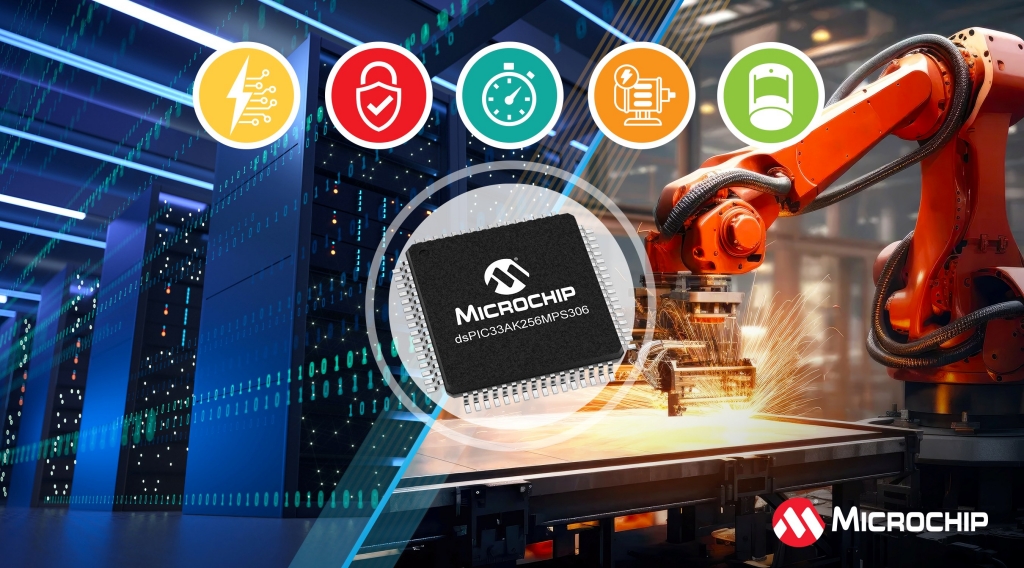
DSC integrating power conversion, motor control, and sensing
Microchip Technology announced on the 15th that it has launched the dsPIC33AK256MPS306 and expanded its dsPIC33A DSC product family. The company cited the increasing demand for high-efficiency power design, deterministic real-time control, and quantum-resistant encryption in AI servers, data centers, automotive, and industrial systems as the background for this product launch.
Based on a 200MHz 32-bit core and a dual-precision floating-point unit, the new device integrates a 78ps resolution PWM, a 40MSPS ADC, a high-speed comparator, and a DAC. This structure supports the implementation of fast and stable control loops in applications such as DC/DC converters, auxiliary power supplies, and power conversion in high-frequency switching environments. In particular, the design incorporates considerations for application in SiC and GaN power semiconductor-based systems.
Security features have also been enhanced. It includes secure boot, firmware updates, and debug functions, and supports CNSA 2.0 recommendation-based post-quantum cryptography (PQC) algorithms and hardware-accelerated cryptography. Additionally, it takes into account the continuous operation environments required for server power devices and the like through a live update function that allows software updates without system interruption.
Considering its application in various industrial environments, this product supports communication interfaces such as I3C, CAN FD, LIN, SPI, I2C, and SENT, and also includes encoder and resolver interfaces for motor control. The implementation of Field-Oriented Control (FOC) based on trigonometric operation performance, along with an integrated touch controller and oversampling ADC function, focuses on simplifying sensing and HMI design.
In addition, it is pursuing vehicle-grade certification that incorporates functional safety processes based on ISO 26262 and IEC 61508 and supports operation up to 150°C. It also considers the scalability of the development environment by supporting open-source RTOS, including Zephyr, and existing development tool systems.
As environments requiring power efficiency, real-time control, security, and functional safety simultaneously expand, a single-chip-based integrated design approach is leading to a reduction in system complexity. This product family expansion is interpreted as an extension of the semiconductor design trend aimed at responding to these industry changes.

Comments
Related news
Microchip Strengthens Its 600V Gate Driver Market for Motor Control and Power Conversion
As demand for high-voltage power management solutions rapidly increases, Microchip Technology has strengthened its market penetration in high-voltage motor control and power conversion by launching a new portfolio of gate driver products supporting operation up to 600V.
2026.01.22by 배종인 기자
Microchip Expands Arm Cortex-M0+-Based Portfolio
Microchip Technology (Asia General Manager and Korea Representative Han Byung-don) has officially launched the PIC32CM PL10 microcontroller (MCU) based on Arm Cortex-M0+, marking the beginning of its full-scale pursuit of the low-power, high-performance embedded market.
2026.02.02by 명세환 기자
Microchip Unveils PIC32CM PL10 MCU, Expanding 5V-Supporting Cortex-M0+ Lineup
Microchip Technology has added the PIC32CM PL10 to its Arm Cortex-M0+ based MCU lineup. The new product features 5V operation support, Core Independent Peripherals (CIP), touch functionality, and compatibility with various development environments. Primary target applications include mass production in industrial control, building automation, and consumer electronics, with pin compatibility with AVR MCUs also considered. The PL10 integrates with the MPLAB development environment and numerous third-party IDEs alongside CMSIS support. Additionally, it is designed for use across diverse system environments through support for industrial safety standards including ISO 26262, operation across a 1.8V to 5.5V voltage range, and multiple voltage I/O capability.
2026.02.04by 명세환 기자
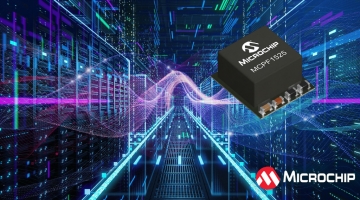
Microchip Launches 'MCPF1525' Power Module for AI Data Centers, Targeting Power Density and Scalability
With increasing demands for power density and efficiency in datacenter power designs driven by AI and high-performance computing (HPC) workloads, Microchip Technology has launched the highly integrated power module 'MCPF1525'. The product features an embedded 16V input buck converter that delivers 25A current per module and can be scaled up to 200A maximum in a stacked configuration. It supports PMBus and I2C control to enhance power management flexibility and employs vertical packaging architecture to reduce board area. Targeting AI servers, PCIe switches, and HPC MPU operation, this product is evaluated as a solution that simultaneously pursues improved power density and simplified design.
2026.02.04by 명세환 기자
.jpg)
Microchip Unveils Full-Stack Edge AI Solution, Ready for Mass Production
Microchip Technology has unveiled a full-stack edge AI solution centered on microcontrollers (MCUs) and microprocessors (MPUs). This solution encompasses silicon through software, development tools, and production-ready applications, focusing on simplifying AI development and deployment processes in edge environments. The solution reflects the expanding demand for edge AI across industrial, automotive, and IoT sectors, which reduces cloud dependency and enables real-time inference and decision-making. Microchip emphasized shortening development cycles by combining pre-trained models with development tools, and highlighted scalability across diverse hardware environments including FPGAs.
2026.02.11by 명세환 기자











