This page was machine-translated and may differ from the original. View original
K-Semiconductor Strategy: How Possible Is It That 'Korea Becomes a Semiconductor Powerhouse by 2030'?

Government concretizes K-semiconductor strategy with 2030 target
Comprehensive coverage of semiconductor upstream and downstream industries, somewhat scattered aspects
Need to find a place to work, companies that talents want to move to
As the United States is adopting a strategy of weaponizing its own semiconductor technology to check China, which is chasing it, China is also responding by making massive investments, saying that it will achieve semiconductor independence. In addition, the world's attention is focused on semiconductors, including Japan, which dreams of reviving the semiconductor industry based on the world's best materials, parts, and equipment competitiveness, the European Union (EU) that wants to regain semiconductor production capacity that is concentrated in East Asia, and Taiwan, which is trying to maintain its strong semiconductor manufacturing advantage by owning foundry companies such as TSMC, UMC, and PSMC.
◇ May 13, inter-ministerial ‘K-Semiconductor Strategy’ announced
Accordingly, the government also announced the 'K-Semiconductor Strategy' at Samsung Electronics' Pyeongtaek Campus, which aims to build the world's best semiconductor supply chain by 2030. From this year to 2030, more than 510 trillion won will be invested in creating the K-Semiconductor Belt and enhancing semiconductor crisis response capabilities.

The formation of the K-semiconductor belt is centered on the participation of companies. The plan is to become the world's largest semiconductor country by supporting the expansion of factories by domestic companies such as Samsung Electronics and SK Hynix, and overseas equipment company Lam Research, establishing a training center for ASML, the exclusive supplier of advanced EUV equipment, investing in packaging, and creating a fabless valley.
In order to secure manufacturing capabilities, a tax credit of up to 40-50% for R&D and up to 10-20% for facility investment is planned, and a special fund for facility investment of over 1 trillion won for semiconductors will be newly established. Regulations related to manufacturing facilities such as chemicals, high-pressure gases, greenhouse gases, and radio application equipment are also expected to be rationalized. A plan is also being promoted for the government and Korea Electric Power Corporation to jointly share up to 50% of the cost of securing 10 years’ worth of semiconductor water supply in Yongin and Pyeongtaek and building power infrastructure for strategic semiconductor manufacturing facilities. In addition, a plan is in place to foster 36,000 new semiconductor-related industrial personnel.
Additionally, 2.5 trillion won will be invested in the development of next-generation power semiconductors such as SiC and GaN, AI semiconductors, and advanced sensors by 2028. Special laws on semiconductors, internalization of the automotive semiconductor supply chain, strengthening of security management of key national technology partners, and carbon neutrality measures are also being promoted.

Minister of Trade, Industry and Energy Moon Seung-wook predicted, “If the K-semiconductor strategy is successful, exports will increase from $99.2 billion (about 112 trillion won) in 2020 to $200 billion (about 226 trillion won) in 2030, and the number of employees will increase from 182,000 in 2019 to 270,000 in 2030.”
◇ June 10, Ministry of Trade, Industry and Energy presents 'K-Semiconductor Pre-qualification Project Promotion Plan'
The Ministry of Trade, Industry and Energy has decided to establish infrastructure such as a mass production test bed for small and medium-sized enterprises and an advanced packaging platform as a follow-up measure to the above strategy. Through the 'K-Semiconductor Large-Scale Pre-Feasibility Study Plan', five large-scale preliminary feasibility study projects of the K-Semiconductor Strategy were specified: △Establishment of a mass production test bed in a specialized complex for small and medium-sized enterprises, △Establishment of an advanced packaging platform, △Large-scale human resource development through public-private joint investment, △Development of K-sensor technology, and △Development of PIM AI semiconductor technology.
The K-Sensor and PIM AI semiconductor technology development projects will begin in earnest in 2022. The two projects are essential for the next-generation manufacturing and semiconductor industries, and their main goals are to support sensor R&D, secure a sensor manufacturing innovation platform and verification infrastructure, and secure PIM (Processing in memory) semiconductor technology that integrates memory and processors. In addition, starting from the year after next, a test bed will be built within the Yongin Semiconductor Cluster, approximately 90 types of packaging technology evaluation equipment will be introduced, and 350 billion won will be invested in training semiconductor industry personnel.
◇ July 1, Inspection of the progress of the pan-ministerial 'K-Semiconductor Strategy'
The government held the 12th Innovation Growth BIG3 Promotion Meeting and reviewed the status of follow-up measures and future plans for the 'K-Semiconductor Strategy'. In this meeting, the government announced that it plans to produce results in earnest in areas such as tax support, financial support, deregulation, infrastructure construction, foreign investment attraction, human resource development, and technology development starting from the second half of this year.
First, in order to support promising semiconductor technology and foster technology and businesses, we plan to select memory, system, and small and medium-sized equipment-related technologies as national strategic technologies, and discussions are currently underway. Based on this, the Ministry of Strategy and Finance plans to announce a national strategic technology plan through a tax law amendment bill within this month, and submit a revision bill for the 'Tax Special Exceptions and Restrictions Act' to the regular National Assembly in September.

△Funding support is being provided to foundries, small and medium-sized enterprises, and packaging companies with investment demand, and △simplification of permits and licenses related to radio wave application equipment, chemical facilities, and dedicated containers is being promoted. △Preliminary consulting for river occupancy permits for the construction and operation of the Yongin semiconductor industrial complex is in progress, and a plan to secure the amount of semiconductor-related water needed in Yongin and Pyeongtaek by the end of the year is being reviewed. In addition, △The design of a production line for securing the EUV cluster site for ASML, a foreign company, and for constructing a manufacturing facility for Lam Research is also in progress.
Regarding human resource development, △Samsung Electronics and the Korea Advanced Institute of Science and Technology (KAIST) announced that they have agreed to establish a semiconductor contract department. In addition, △the semiconductor human resource development project is planned to apply for a preliminary feasibility study in the third quarter with a scale of 350 billion won. New projects to strengthen semiconductor practical education, such as expanding support for the Semiconductor Design Education Center (IDEC), will also be fully implemented starting in 2022.
The budget for next year is being reflected in the △K-sensor and PIM semiconductor development projects that applied for a preliminary feasibility study in the fourth quarter of last year, and non-preliminary feasibility studies R&D projects such as next-generation power and AI semiconductors are also being prepared. In addition, in order to foster key national strategic industries such as semiconductors, the so-called 'Special Act on Strengthening and Protecting the Competitiveness of Key National Strategic Industries' is being prepared. In the future, we plan to consult with relevant ministries and the National Assembly in connection with the main contents to be reflected in the 'Semiconductor Special Act'.
On this day, Minister Moon also said, “It is a time when we need to expand support in the areas of taxation and finance so that the semiconductor manufacturing base that major countries have been competitively supporting can be established domestically first,” and added, “I ask for the active interest and effort of relevant ministries and the private sector so that we can establish a foundation for the mid- to long-term growth of the domestic semiconductor industry.”
◇ Need for improvement in semiconductor demand creation and talent attraction
This series of policy announcements is seen as demonstrating the government's will to foster the domestic semiconductor industry in response to the movements of major countries around the world. However, it appears to have limitations in that the scope of support is broad, there is little differentiation from other countries' policies, and it is not yet specific.

On June 8, under the direction of US President Joe Biden, the US Department of Commerce submitted a report summarizing the semiconductor supply chain situation in the US for the past 100 days. The report analyzed the five essential sectors of semiconductors: design, manufacturing, post-processing, materials, and equipment. The US showed great strength in the design sector, liquids and gases for semiconductor manufacturing, and semiconductor equipment other than exposure, but manufacturing, post-processing, semiconductor materials, and exposure equipment were heavily dependent on overseas countries.
The US has been revealed to be behind Taiwan in terms of semiconductor manufacturing and behind China in terms of demand. In particular, China is the world's manufacturing plant, and its semiconductor demand is much higher than other countries, so the semiconductor upstream and downstream industries are developing rapidly. The fact that semiconductor companies in various fields such as Dongxin (memory), BYD (automotive), and Haoda (wireless) applied for initial public offerings (IPOs) around the end of June gives us an idea of how fast China's semiconductor industry is developing.
The point is demand. The growth of the entire semiconductor industry is determined by domestic demand for semiconductors. There are world-class electronics companies in Korea, but they do not generate the same level of demand for semiconductors as Chinese companies. Therefore, even if there are no companies that benefit immediately, it seems necessary to have a policy of providing subsidies when purchasing domestically produced or domestically designed semiconductors. This is not something that can be left to companies like Samsung Electronics and SK Hynix alone.
The shortage of automotive semiconductors that triggered the semiconductor supply instability was due to a shortage of chips based on 8-inch wafers. According to IEEE Spectrum, chips based on 8-inch wafers and 40nm and above account for 54% of total semiconductor demand. While advanced process development is important, design and manufacturing capabilities for semiconductors manufactured using less-fine processes are also needed.
Also, fostering companies that talents want to work for is more important than fostering talent. The semiconductor industry relies more on talent than on resources. The fact that many global semiconductor companies are still concentrated in the United States is evidence of this. The United States is wary that about 40% of its semiconductor talents are from overseas. Conversely, this means that overseas talents want to work for American semiconductor companies because of the pay. While fostering new talent is good, we should also consider ways to support the transfer of existing talents to domestic companies.
Comprehensive coverage of semiconductor upstream and downstream industries, somewhat scattered aspects
Need to find a place to work, companies that talents want to move to
As the United States is adopting a strategy of weaponizing its own semiconductor technology to check China, which is chasing it, China is also responding by making massive investments, saying that it will achieve semiconductor independence. In addition, the world's attention is focused on semiconductors, including Japan, which dreams of reviving the semiconductor industry based on the world's best materials, parts, and equipment competitiveness, the European Union (EU) that wants to regain semiconductor production capacity that is concentrated in East Asia, and Taiwan, which is trying to maintain its strong semiconductor manufacturing advantage by owning foundry companies such as TSMC, UMC, and PSMC.
◇ May 13, inter-ministerial ‘K-Semiconductor Strategy’ announced
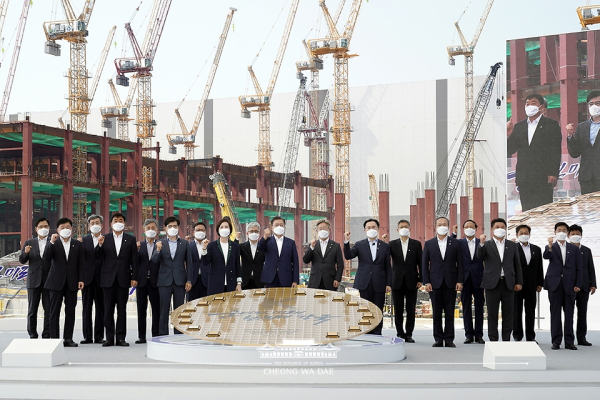
Accordingly, the government also announced the 'K-Semiconductor Strategy' at Samsung Electronics' Pyeongtaek Campus, which aims to build the world's best semiconductor supply chain by 2030. From this year to 2030, more than 510 trillion won will be invested in creating the K-Semiconductor Belt and enhancing semiconductor crisis response capabilities.

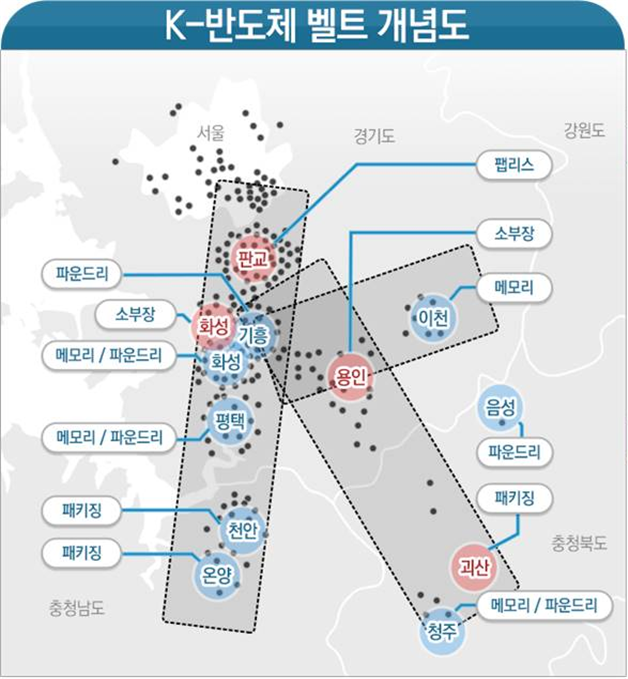
▲ K-Semiconductor Belt Concept [Image = Ministry of Trade, Industry and Energy]
The formation of the K-semiconductor belt is centered on the participation of companies. The plan is to become the world's largest semiconductor country by supporting the expansion of factories by domestic companies such as Samsung Electronics and SK Hynix, and overseas equipment company Lam Research, establishing a training center for ASML, the exclusive supplier of advanced EUV equipment, investing in packaging, and creating a fabless valley.
In order to secure manufacturing capabilities, a tax credit of up to 40-50% for R&D and up to 10-20% for facility investment is planned, and a special fund for facility investment of over 1 trillion won for semiconductors will be newly established. Regulations related to manufacturing facilities such as chemicals, high-pressure gases, greenhouse gases, and radio application equipment are also expected to be rationalized. A plan is also being promoted for the government and Korea Electric Power Corporation to jointly share up to 50% of the cost of securing 10 years’ worth of semiconductor water supply in Yongin and Pyeongtaek and building power infrastructure for strategic semiconductor manufacturing facilities. In addition, a plan is in place to foster 36,000 new semiconductor-related industrial personnel.
Additionally, 2.5 trillion won will be invested in the development of next-generation power semiconductors such as SiC and GaN, AI semiconductors, and advanced sensors by 2028. Special laws on semiconductors, internalization of the automotive semiconductor supply chain, strengthening of security management of key national technology partners, and carbon neutrality measures are also being promoted.
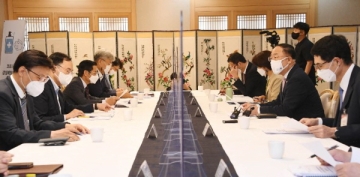
▲ Samsung Electronics announces K-semiconductor strategy at Pyeongtaek Campus
Government officials [Photo = Blue House]
Minister of Trade, Industry and Energy Moon Seung-wook predicted, “If the K-semiconductor strategy is successful, exports will increase from $99.2 billion (about 112 trillion won) in 2020 to $200 billion (about 226 trillion won) in 2030, and the number of employees will increase from 182,000 in 2019 to 270,000 in 2030.”
◇ June 10, Ministry of Trade, Industry and Energy presents 'K-Semiconductor Pre-qualification Project Promotion Plan'
The Ministry of Trade, Industry and Energy has decided to establish infrastructure such as a mass production test bed for small and medium-sized enterprises and an advanced packaging platform as a follow-up measure to the above strategy. Through the 'K-Semiconductor Large-Scale Pre-Feasibility Study Plan', five large-scale preliminary feasibility study projects of the K-Semiconductor Strategy were specified: △Establishment of a mass production test bed in a specialized complex for small and medium-sized enterprises, △Establishment of an advanced packaging platform, △Large-scale human resource development through public-private joint investment, △Development of K-sensor technology, and △Development of PIM AI semiconductor technology.
The K-Sensor and PIM AI semiconductor technology development projects will begin in earnest in 2022. The two projects are essential for the next-generation manufacturing and semiconductor industries, and their main goals are to support sensor R&D, secure a sensor manufacturing innovation platform and verification infrastructure, and secure PIM (Processing in memory) semiconductor technology that integrates memory and processors. In addition, starting from the year after next, a test bed will be built within the Yongin Semiconductor Cluster, approximately 90 types of packaging technology evaluation equipment will be introduced, and 350 billion won will be invested in training semiconductor industry personnel.
◇ July 1, Inspection of the progress of the pan-ministerial 'K-Semiconductor Strategy'
The government held the 12th Innovation Growth BIG3 Promotion Meeting and reviewed the status of follow-up measures and future plans for the 'K-Semiconductor Strategy'. In this meeting, the government announced that it plans to produce results in earnest in areas such as tax support, financial support, deregulation, infrastructure construction, foreign investment attraction, human resource development, and technology development starting from the second half of this year.
First, in order to support promising semiconductor technology and foster technology and businesses, we plan to select memory, system, and small and medium-sized equipment-related technologies as national strategic technologies, and discussions are currently underway. Based on this, the Ministry of Strategy and Finance plans to announce a national strategic technology plan through a tax law amendment bill within this month, and submit a revision bill for the 'Tax Special Exceptions and Restrictions Act' to the regular National Assembly in September.

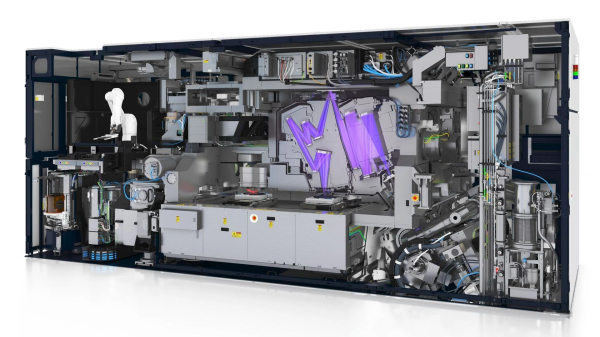
▲ ASML is an essential EUV for advanced semiconductor processes
It is the only company in the industry that produces equipment [Photo = ASML]
△Funding support is being provided to foundries, small and medium-sized enterprises, and packaging companies with investment demand, and △simplification of permits and licenses related to radio wave application equipment, chemical facilities, and dedicated containers is being promoted. △Preliminary consulting for river occupancy permits for the construction and operation of the Yongin semiconductor industrial complex is in progress, and a plan to secure the amount of semiconductor-related water needed in Yongin and Pyeongtaek by the end of the year is being reviewed. In addition, △The design of a production line for securing the EUV cluster site for ASML, a foreign company, and for constructing a manufacturing facility for Lam Research is also in progress.
Regarding human resource development, △Samsung Electronics and the Korea Advanced Institute of Science and Technology (KAIST) announced that they have agreed to establish a semiconductor contract department. In addition, △the semiconductor human resource development project is planned to apply for a preliminary feasibility study in the third quarter with a scale of 350 billion won. New projects to strengthen semiconductor practical education, such as expanding support for the Semiconductor Design Education Center (IDEC), will also be fully implemented starting in 2022.
The budget for next year is being reflected in the △K-sensor and PIM semiconductor development projects that applied for a preliminary feasibility study in the fourth quarter of last year, and non-preliminary feasibility studies R&D projects such as next-generation power and AI semiconductors are also being prepared. In addition, in order to foster key national strategic industries such as semiconductors, the so-called 'Special Act on Strengthening and Protecting the Competitiveness of Key National Strategic Industries' is being prepared. In the future, we plan to consult with relevant ministries and the National Assembly in connection with the main contents to be reflected in the 'Semiconductor Special Act'.
On this day, Minister Moon also said, “It is a time when we need to expand support in the areas of taxation and finance so that the semiconductor manufacturing base that major countries have been competitively supporting can be established domestically first,” and added, “I ask for the active interest and effort of relevant ministries and the private sector so that we can establish a foundation for the mid- to long-term growth of the domestic semiconductor industry.”
◇ Need for improvement in semiconductor demand creation and talent attraction
This series of policy announcements is seen as demonstrating the government's will to foster the domestic semiconductor industry in response to the movements of major countries around the world. However, it appears to have limitations in that the scope of support is broad, there is little differentiation from other countries' policies, and it is not yet specific.
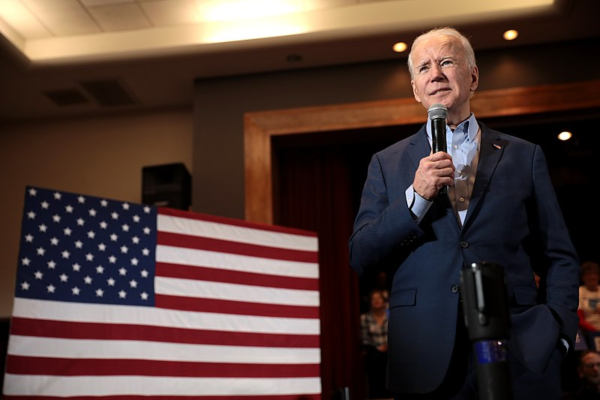
▲ Even the United States, which has strong semiconductor capabilities, has its own shortcomings.
Struggling with the semiconductor supply chain [Photo = Gage Skidmore]
On June 8, under the direction of US President Joe Biden, the US Department of Commerce submitted a report summarizing the semiconductor supply chain situation in the US for the past 100 days. The report analyzed the five essential sectors of semiconductors: design, manufacturing, post-processing, materials, and equipment. The US showed great strength in the design sector, liquids and gases for semiconductor manufacturing, and semiconductor equipment other than exposure, but manufacturing, post-processing, semiconductor materials, and exposure equipment were heavily dependent on overseas countries.
The US has been revealed to be behind Taiwan in terms of semiconductor manufacturing and behind China in terms of demand. In particular, China is the world's manufacturing plant, and its semiconductor demand is much higher than other countries, so the semiconductor upstream and downstream industries are developing rapidly. The fact that semiconductor companies in various fields such as Dongxin (memory), BYD (automotive), and Haoda (wireless) applied for initial public offerings (IPOs) around the end of June gives us an idea of how fast China's semiconductor industry is developing.
The point is demand. The growth of the entire semiconductor industry is determined by domestic demand for semiconductors. There are world-class electronics companies in Korea, but they do not generate the same level of demand for semiconductors as Chinese companies. Therefore, even if there are no companies that benefit immediately, it seems necessary to have a policy of providing subsidies when purchasing domestically produced or domestically designed semiconductors. This is not something that can be left to companies like Samsung Electronics and SK Hynix alone.
The shortage of automotive semiconductors that triggered the semiconductor supply instability was due to a shortage of chips based on 8-inch wafers. According to IEEE Spectrum, chips based on 8-inch wafers and 40nm and above account for 54% of total semiconductor demand. While advanced process development is important, design and manufacturing capabilities for semiconductors manufactured using less-fine processes are also needed.
Also, fostering companies that talents want to work for is more important than fostering talent. The semiconductor industry relies more on talent than on resources. The fact that many global semiconductor companies are still concentrated in the United States is evidence of this. The United States is wary that about 40% of its semiconductor talents are from overseas. Conversely, this means that overseas talents want to work for American semiconductor companies because of the pay. While fostering new talent is good, we should also consider ways to support the transfer of existing talents to domestic companies.
본 기사에 대한 정정·반론·추후보도 청구는 보도 청구 안내를, 그간 게재된 보도문은 정정·반론보도 모아보기를 참고해 주세요.

.png)