


Semiconductor industry in full recovery, expected to grow 7.2% this year from 1.5% last year
 Published2017.01.25 16:24
Recovery since the end of Q2 2016, with industrial, automotive and storage markets in the spotlight
Gartner Inc., a global IT consulting firm, announced that global semiconductor revenue in 2017 is expected to reach $364.1 billion, a 7.2% increase from the previous year. The semiconductor market, which recorded 1.5% growth in 2016, is expected to fully recover this year.
“The global semiconductor market has bounced back from its worst situation and the outlook for 2016 is positive,” said Ganesh Ramamoorthy, research vice president at Gartner. “This will be driven by inventory replenishment and higher average selling prices in some specialty markets, such as commodity memory and ASSPs (application-specific standard products). The semiconductor market has been recovering since the end of the second quarter of 2016 and is expected to maintain its upward trend and continue its positive performance throughout 2016.”
Gartner’s 2017 global semiconductor revenue forecast has been revised upward by $14.1 billion from its previous forecast, with the memory market accounting for about $10 billion. Vice President Ganesh Ramamurthy said, “The supply and demand situation in the memory market is working positively for memory semiconductor companies that are raising their average selling prices to recover their margins. “Another key factor driving revenue growth was the increase in average selling prices for semiconductor components used in key applications such as ASSPs, devices and analog semiconductors, and the Internet of Things (IoT),” he said.
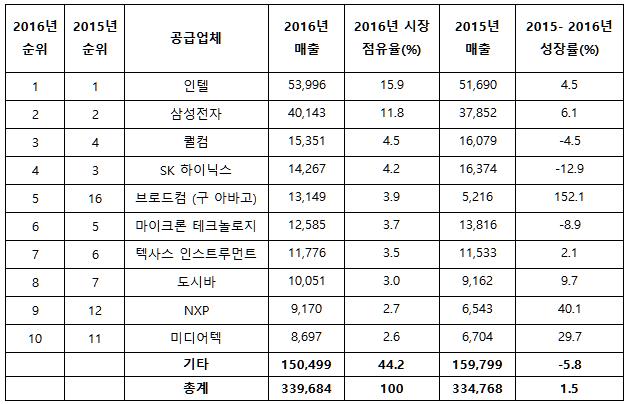
▲Top 10 semiconductor suppliers by global sales in 2016 (unit: million dollars)Source: Gartner (January 2017)
Overall, while 2016 was a mixed growth year, 2017 is expected to be a broad and more sustained growth year. The industrial, automotive, and storage markets are the sectors to watch this year, and while these sectors are showing rapid growth, their share of the overall market is small. In addition, as growth in traditional applications such as smartphones and PCs is expected to slow down, the semiconductor market in new sectors such as IoT is becoming important.
“These facts mean that semiconductor product managers who have relied on traditional applications must now continue to explore opportunities arising from new application areas emerging from the IoT, as well as from industrial, storage and automotive markets,” said Ganesh Ramamurthy, vice president.
Intel Ranks No. 1 in Semiconductor Sales for 25th Consecutive Year, Preliminary Results for 2016
Meanwhile, according to preliminary results released by Gartner Inc., worldwide PC semiconductor sales in 2016 reached $339.7 billion, a 1.5% increase from 2015, when it recorded $334.8 billion. The top 25 semiconductor suppliers' combined sales increased 7.9% year-over-year, accounting for 75.9% of the total market.
“After a slow start to 2016 due to inventory depletion, semiconductor revenue accelerated in the second half of the year on inventory replenishment and improving demand and pricing,” said Adriana Blanco, principal analyst at Gartner. “Overall, semiconductor revenue in the second half of the year grew significantly compared to the first half, reflecting the strength of the memory market, continued inventory replenishment, and inventory buildup from the iPhone 7 launch and holiday season.”
Intel held the top spot for the 25th consecutive year, with 15.9% of the market. Samsung Electronics held the second place for the 15th consecutive year, with 11.8%. Broadcom Ltd. was the best performer among the top 25, rising 11 places to No. 5 after Broadcom Corporation acquired Avago Technologies.
Wireless market sales grow 9.6%, led by smartphone and memory markets
“The end-application market has been the largest semiconductor market for wireless and compute, but 2016 was a very different story,” said Adriana Blanco, research analyst. “Wireless revenue grew 9.6 percent, driven by exposure to smartphones and memory. Compute revenue, on the other hand, declined 8.3 percent, continuing the downward trend in the stagnant PC and tablet markets and memory.”
The 2016 memory market began with oversupply and falling prices in the DRAM and NAND markets. Both markets saw significant price increases in mid-2016 due to inventory shortages. The NAND flash market in particular had a slow start in early 2016 due to oversupply, but growth accelerated in the second half of the year due to deepening supply shortages and rising prices.
In terms of macroeconomic factors this year, the euro has been relatively stable against the dollar, while the yen has strengthened considerably. Meanwhile, the UK's decision to leave the EU in June last year had a minimal impact on the global semiconductor market, but demand for semiconductor equipment in the UK has been hit by rising prices due to the weaker pound.
Comments
Related news
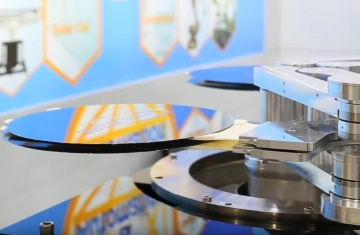
Semiconductor equipment shipments in October increased by 9% compared to the previous month, but orders fell by 5%.
According to the October BB Ratio Report announced by SEMI (Semiconductor Equipment and Materials International), the North American semiconductor equipment manufacturers' net orders (3-month average) for October 2016 were $1.49 billion, with a BB ratio of 0.91. The BB ratio is calculated by dividing orders by shipments. A BB ratio of 0.91 means that for every $100 in shipments, there are $91 in orders.
2016.11.24by 신윤오 기자
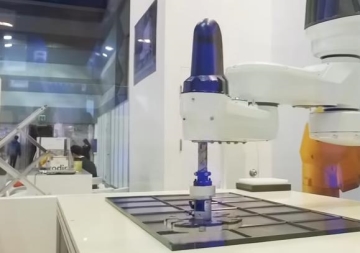
Global semiconductor equipment sales in the third quarter increased 5% compared to the second quarter.
SEMI, the international semiconductor equipment and materials association, announced that global semiconductor manufacturing equipment shipments in the third quarter of 2016 reached $11 billion. This figure represents a 5% increase compared to the second quarter figures and a 14% increase compared to the third quarter of 2015. SEMI compiles its reports based on data collected on a monthly basis from 95 global equipment companies in cooperation with the Japan Semiconductor Equipment Association (SEAJ).
2016.12.08by 홍보라 기자
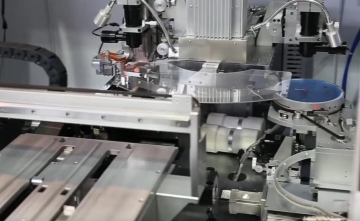
Semiconductor equipment sales rise due to investments in 3D NAND, advanced foundry, and advanced packaging
According to the November BB ratio report released by SEMI, the Semiconductor Equipment and Materials International, the North American semiconductor equipment manufacturers' net bookings for November 2016 (three-month average) reached $1.55 billion, with a BB ratio of 0.96. The BB ratio is calculated by dividing bookings by billings, and a BB ratio of 0.96 means that bookings are $96 for every $100 in billings.
2016.12.23by 김수지 기자

From semiconductors and sensors to artificial intelligence, the counterattack of 'IoT appliances' has begun
The intelligent home appliance industry, which plays a leading role in smart home or home IoT, is expected to expand in earnest in the new year. The global smart home market is anticipated to grow from $60 billion in 2015 to $133.6 billion in 2020, with IoT home appliances expected to grow from $5.2 billion in 2015 to $34 billion in 2020, representing an average annual growth rate of 48%. Last year, the domestic smart home market size was estimated at 10 trillion won, with IoT home appliances accounting for 3.3 trillion won.
2016.12.26by 신윤오 기자

LoRa semiconductors for IoT-exclusive networks launched successively, will endpoint devices expand?
Following the establishment of a LoRa network base dedicated to IoT centered on SK Telecom last year, as dedicated devices are spreading, interest in key semiconductor solutions is growing. STMicroelectronics (hereinafter ST) announced that it successfully demonstrated the world's first real-time, multi-target location tracking demo using the LoRaWAN LPWAN protocol together with IoT solution companies myDevices and Senet at CES 2017, which concluded on the 9th.
2017.01.16by 신윤오 기자











