


Global Semiconductor Sales Forecast: 2018 "Sunny," 2019 "Damp"
 Published2019.01.07 09:02
Memory accounted for 34.8% of total semiconductor sales in 2018
Changes in industry rankings expected in 2019 due to market weakening

Gartner
On the 7th, Gartner announced preliminary results regarding global semiconductor sales for 2018.
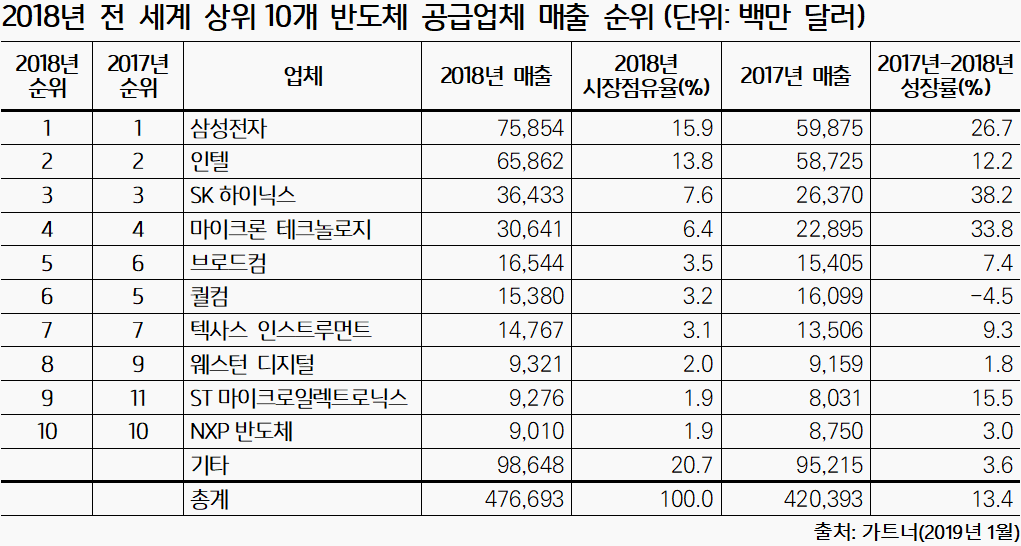
According to Gartner, global semiconductor revenue in 2018 reached $476.7 billion, a 13.4% increase from 2017. In particular, memory firmly established itself as the largest semiconductor sector, with its share of total semiconductor revenue rising from 31% in 2017 to 34.8% in 2018.
Andrew Norwood, Vice President and Analyst at Gartner, explained, "Samsung Electronics, the world's largest semiconductor company, has solidified its position as the world's number one thanks to the strong performance of the DRAM market," adding, "While the growth trend of 2017 continued into 2018, total memory sales in 2018 were only half the growth rate of 2017, because the downturn in the memory market began in the second half of 2018."
The combined revenue of the top 25 semiconductor suppliers increased by 16.3% in 2018, accounting for 79.3% of the total market. The reason they recorded outstanding performance compared to the rest of the companies, which saw only a meager 3.6% increase in sales, is that memory suppliers are concentrated among the top 25 companies.
Intel's semiconductor revenue increased by 12.2% compared to 2017, influenced by the number of units sold and the average selling price.
Major memory suppliers that showed strength in 2018 include SK Hynix, driven by the growth of the DRAM market, and Microchip Technology, which benefited from the acquisition of Microsemi.
The top four companies in 2017 maintained the same rankings in 2018 without change.
"Vice President Norwood stated, 'The memory market is expected to weaken in 2019, and there could be significant shifts in industry rankings this year,' adding, 'Tech product managers must prepare for this limited growth to succeed in the semiconductor business.'"
For example, memory suppliers must invest in research and development regarding continuous node transitions, new memory technologies, and new manufacturing techniques to prepare countermeasures against future oversupply and intense margin pressure. With new Chinese companies entering the market, such countermeasures can enable the establishment of an optimal cost structure.
Non-memory suppliers must increase design-in activities with key customers who have tolerated high memory prices. As the smartphone and tablet markets remain saturated, application processor suppliers must seek adjacent opportunities in fields such as wearables, IoT endpoints, and automobiles.
Among semiconductor devices, memory was identified as the device segment that accounted for the largest share and performed best, recording a 27.2% increase in sales and a 35% market share in 2018. This is because the average selling price of DRAM increased for most of the year, excluding the fourth quarter of 2018.
In the memory sector, NAND flash struggled throughout 2018 due to oversupply, which caused average selling prices to decline. However, driven by increased SSD adoption and growing smartphone content, it recorded a 6.5% increase in revenue.
Application-Specific Semiconductors (ASSP), the second-largest semiconductor segment, showed limited growth of 5.1% due to the slump in the smartphone market and the weakness in the tablet market. Major suppliers in this field, such as Qualcomm and MediaTek, are actively expanding their businesses into adjacent markets with high growth potential, such as automotive and IoT applications.
2018 was a year where the mergers and acquisitions that did not materialize were more meaningful than those that did.
Comments
Related news
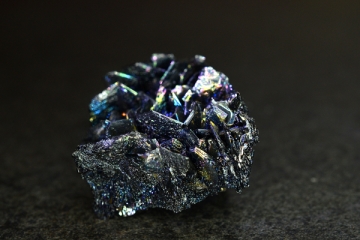
KETI Successfully Develops Solid-State Bonding Technology for SiC Power Semiconductor Packaging
The Electronics and Telecommunications Research Institute has developed a solid-state bonding technology using silver for the assembly of silicon carbide power semiconductors. Solid-state bonding refers to the process of joining different types of materials in their unfused solid state without melting. Silicon carbide semiconductors, along with gallium nitride and others, are wide bandgap semiconductors that exhibit stable high-temperature operation, high thermal conductivity, low resistance, and high voltage withstand capability compared to conventional silicon semiconductors.
2018.12.11by 이수민 기자
Maxim Launches 6 Ultra-Small SIMO PMICs for IoT Devices
Maxim Integrated Korea announced on the 11th the launch of six ultra-compact, low-power power management semiconductors that extend battery life. The MAX17270, MAX77278, MAX77640, MAX77641, MAX77680, and MAX77681 PMICs reduce the power management footprint by up to 50% for size-constrained products such as wearables, hearables, sensors, smart home automation hubs, and IoT devices. Maxim's new PMICs improve overall system efficiency by 9% compared to competing products and reduce heat dissipation, an important consideration for wearable products that contact skin.
2018.12.12by 이수민 기자
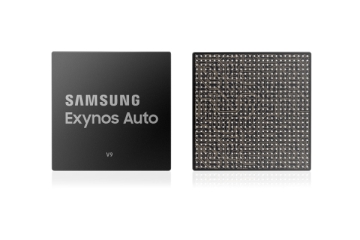
Samsung Electronics Starts Launch of Automotive Semiconductors
Samsung Electronics will supply Audi with the automotive semiconductor "Exynos Auto V9" for next-generation infotainment systems in 2021. The Exynos Auto V9 is a high-performance, low-power processor for premium infotainment systems that Samsung Electronics is introducing for the first time since unveiling the "Exynos Auto" automotive semiconductor brand in October 2018.
2019.01.03by 이수민 기자
Intel Unveils Next-Generation 'Core Ultra Series 3' and vPro Platform for Enterprise PCs
Intel has officially unveiled the "Intel Core Ultra Series 3" for next-generation enterprise PCs and the latest vPro platform, addressing a wide range of demands from enterprise notebooks to high-performance workstations.
2026.03.26by 배종인 기자
ROHM Launches ESD Protection Diode Compatible with High-Speed Interfaces of 10Gbps or Higher
Semiconductor specialist ROHM has developed the 'RESDxVx series' of ESD (electrostatic discharge) protection diodes capable of responding to next-generation high-speed data communication environments exceeding 10Gbps, simultaneously enhancing both signal quality maintenance required in high-speed interfaces and IC protection performance.
2026.03.26by 배종인 기자











