


Will the ongoing semiconductor supply and demand instability change the foundry landscape?
 Published2021.03.27 08:12
Mobility-driven semiconductor supply instability, foundry expansion
Difficult, not easily resolved... EU, US draw sword
The instability in the supply and demand of automotive semiconductors is drawing attention to the foundry industry. This instability is also attributed to failures in demand forecasting by major automotive semiconductor companies, including NXP, Renesas, Infineon, TI, and Microchip. SK Securities analyst Kim Young-woo also attributed the surge in demand from automakers to the situation.
Last November, GM CEO Mary Barra announced that the company would invest $27 billion (approximately 30 trillion won) in electric vehicles and autonomous driving features by 2025. At the same time, the company unveiled innovative mobility solutions, including its own semi-autonomous driving system, Super Cruise; a single-seat vertical takeoff and landing drone; the Cadillac Halo Portfolio autonomous vehicle; the EP1 electric pallet truck; and the EV600 electric van.
At the "Power Day" event held on March 15, Volkswagen CEO Herbert Diess set the share of electric vehicles among the company's vehicles sold in the U.S. and European markets at 50% and 70%, respectively, by 2030. These aggressive electric vehicle strategies by GM and Volkswagen stemmed from a sense of crisis about Tesla.
Tesla has set a strategy to sell 20 million electric vehicles annually by 2030, and at its Battery Day event last September, it announced that it would release a $25,000 electric vehicle with autonomous driving capabilities by 2023.
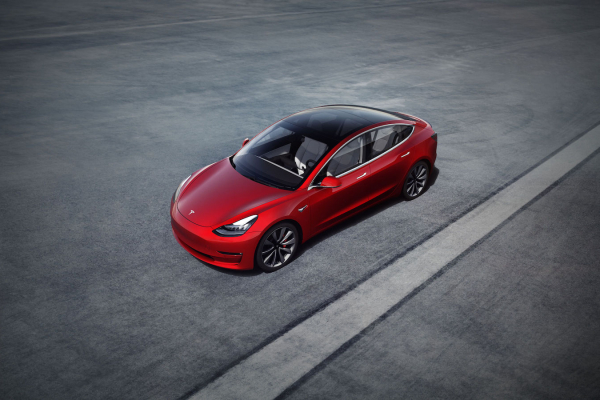
It's in the mid-50 million won range [Photo = Tesla]
Automakers now face the challenge of delivering affordable electric vehicles and autonomous driving capabilities before a game-changer emerges that shakes up the automotive landscape.
However, for companies that entered the market late to secure electric vehicle and autonomous driving technology on par with Tesla, it is inevitable to adopt a large number of high-performance sensors and high-performance computing systems capable of processing the data generated from them.
On January 9th, China's NIO unveiled its proprietary autonomous driving function, "NAD." NAD's core component, the "Aquila" sensor module, consists of 11 8-megapixel cameras, 1 1,550nm lidar sensor, 5 millimeter wave (mmWave) radar sensors, 12 ultrasonic sensors, 2 GPUs, 1 V2X, and an ADMS (Driver Monitoring System).
In particular, ADMS is equipped with four NVIDIA 'Orin' chips and also adopted Qualcomm's 'Snapdragon Automotive 5G Platform' for V2X function. On the other hand, Tesla's 'FSD' uses a 1.2-megapixel camera and is considered advanced technology even though it does not have a lidar sensor.
A surge in demand for semiconductors and foundries is now inevitable to improve the level of advanced driver assistance systems (ADAS), expand electric vehicle production, and secure autonomous driving capabilities.
◇ Demand is growing, but foundry expansion is not easy.
Semiconductor demand in the first half of 2021 increased due to the increased demand for IT devices amid widespread social distancing measures and structural changes in the automotive industry stemming from the Tesla revolution. The surge in virtual asset prices, particularly Bitcoin, also fueled this growth.
On the other hand, supply is unable to keep up with increasing demand.
The high-end foundry supply shortage is caused by ASML's limited EUV equipment supply capacity and declining yields due to process miniaturization. ASML only recently began hiring engineers on a large scale. It seems unlikely that EUV supply capacity will improve this year.
Expanding mid-range foundry supply also appears challenging due to the lack of investment capacity at companies like UMC and GlobalFoundries. TSMC and Samsung Electronics, which have significant investment capacity, are focusing their investments on expanding foundry capacity for 10nm and below. There are no signs of significant capacity expansion until the first quarter of 2021. Foundries based on 8-inch wafers are struggling to expand capacity due to the difficulty in obtaining even used equipment.
Foundry investment was very strong from 2017 to 2020. However, the increase was concentrated in TSMC, Samsung Electronics, and SMIC. In particular, SMIC aggressively expanded its investment to enter the sub-10nm foundry market, but failed to enter the market as it was unable to purchase EUV equipment due to US sanctions.
Unexpected natural disasters are also a factor. Last February, a cold snap, the first in 30 years, forced Samsung Electronics' S2 fab in Austin, Texas, to shut down, along with nearby fabs from NXP and Infineon. NXP in the Netherlands and Infineon in Germany are the world's top two automotive semiconductor manufacturers. Renesas, the world's third-largest semiconductor manufacturer, is also experiencing production disruptions due to the earthquake and fire.
◇ The West is once again striving for semiconductor independence.
The ongoing semiconductor shortage is impacting the entire manufacturing industry, disrupting production. Ford in the U.S. has cut its first-quarter production target by 20%, and GM has also emphasized the inevitability of production cuts. High-ranking government officials from major manufacturing-centric countries, including South Korea, are visiting the Taiwanese government and TSMC officials to urge them to expand capacity.
To transform the foundry ecosystem's dependence on Asia, the European Union (EU) announced plans to invest €1 billion (approximately KRW 1.3 trillion) to secure up to €50 billion (approximately KRW 66.7 trillion) in semiconductor manufacturing capacity. The goal is to produce 20% of the world's semiconductors in Europe, a figure currently hovering around 8.5%. Apple, too, has agreed, planning to invest €1 billion in a semiconductor center in Germany.
The United States views the semiconductor industry as a national security priority. To maximize its competitiveness in semiconductor manufacturing and secure stable domestic production capacity, the United States plans to significantly expand its production bases through financial and infrastructure support, as well as tax breaks, similar to China's "semiconductor boom."
The plan is to awaken a giant that has been in the making. On the 24th of this month, Intel, the world's largest semiconductor company by revenue, announced its entry into the foundry market, investing $20 billion (approximately 23 trillion won) to build two fabs in Arizona, USA. This comes exactly one month after President Joe Biden signed an executive order on February 24th, initiating a review of the semiconductor supply chain.
The sense of crisis brought about by the shortage of automotive semiconductors is leading to changes in the foundry industry.
Comments
Related news
Foundry Process Competition, Following 'EUV', 3D "GAA" Ignites
Foundry competition is currently centered on EUV technology. Since only TSMC, which holds the top foundry market share, and Samsung Electronics, in second place, have adopted EUV processes, demand is concentrated with these two companies. Samsung Electronics plans to introduce MBCFET based on GAA technology, a three-dimensional structure, at the 3nm node. TSMC also intends to adopt the GAA approach, similar to Samsung Electronics, starting from the 2nm process and below.
2021.01.23by 이수민 기자
Wireless BMS: How to Increase EV Driving Range?
Many consumers are hesitant about purchasing electric vehicles due to their shorter maximum driving range compared to internal combustion engine vehicles. The battery management system (BMS) is the component that has the greatest impact on the efficiency of electric vehicles. If wireless solutions could replace the currently widespread wired BMS solutions, it would provide a competitive advantage in the emerging electric vehicle industry through increased driving range.
2021.02.12by 이수민 기자

5 Winds of Change to Blow Through the Automotive Industry in 2021
This year's automotive industry is expected to continuously embrace new technologies and approaches to establish a foundation for autonomous driving business. Willard Tu, Senior Director of Xilinx's Automotive Business Division, predicts five changes that will sweep through the automotive industry this year: the expansion of AI technology to areas beyond ADAS, autonomous commercial vehicles laying the groundwork for autonomous passenger vehicles, suburban areas growing alongside electric vehicle infrastructure, the emerging battery recycling business, and the beginning of adaptive platformization of personally-owned vehicles.
2021.02.19by 명세환 기자

[e4ds Tech Day 2026 ⑨] Sim Sang-gyu, Autocrypt CTO: "In the Physical AI Era, Automotive Security Must Extend Beyond the Vehicle"
At e4ds Tech Day 2026, Sim Sang-gyu, CTO of Autocrypt, explained automotive cybersecurity strategies in the era of Physical AI and SDV (Software-Defined Vehicle). Automobiles are evolving as part of an ecosystem connected to AI, cloud, chargers, IoT, and robots, and he emphasized that the scope of security must expand beyond the vehicle interior to the entire connected environment. In particular, AI model tampering, adversarial attacks, OTA updates, and EV charger hacking were identified as major threats. He explained that response measures require zero trust, AI model integrity protection, intrusion detection, Security by Design and Default, and full lifecycle security management, and that proactive security system establishment beyond regulatory compliance is critical for securing future mobility competitiveness.
2026.10.12by 배종인 기자

Practical HIL Construction Strategy for Automotive and Off-Highway Controller Validation
As vehicle E/E architecture transitions to zonal structures and shifts to software-defined vehicles (SDV), the number of controllers (ECUs) requiring validation and software complexity are surging dramatically. Meanwhile, real vehicle testing cannot provide repeated verification under identical conditions and entails lead time and safety concerns. This white paper explains the principles of HIL (Hardware-in-the-Loop) validation and the structure of the NI platform composed of PXI, SLSC, and VeriStand, and through two actual implementation cases—Camera Record & Replay HIL for In-Cabin Monitoring Controller (ICMU) and Forklift Controller (VCU) HILS—describes how controller-level regression testing becomes possible. Additionally, it explicitly states application boundaries and limitations, such as lack of A2B support.
2026.10.12by 편집부











